COMPRESSION CHECK
HINT: If there is lack of power, excessive oil con–
sumptiom or poor fuel economy, measure the com–
pression pressure.
1. WARM UP AND STOP ENGINE
Allow the engine to warm up to normal operating
temperature.
2. REMOVE AIR CLEANER HOSE
3. DISCONNECT COLD START INJECTOR
CONNECTOR
4. DISCONNECT IGNITER CONNECTOR
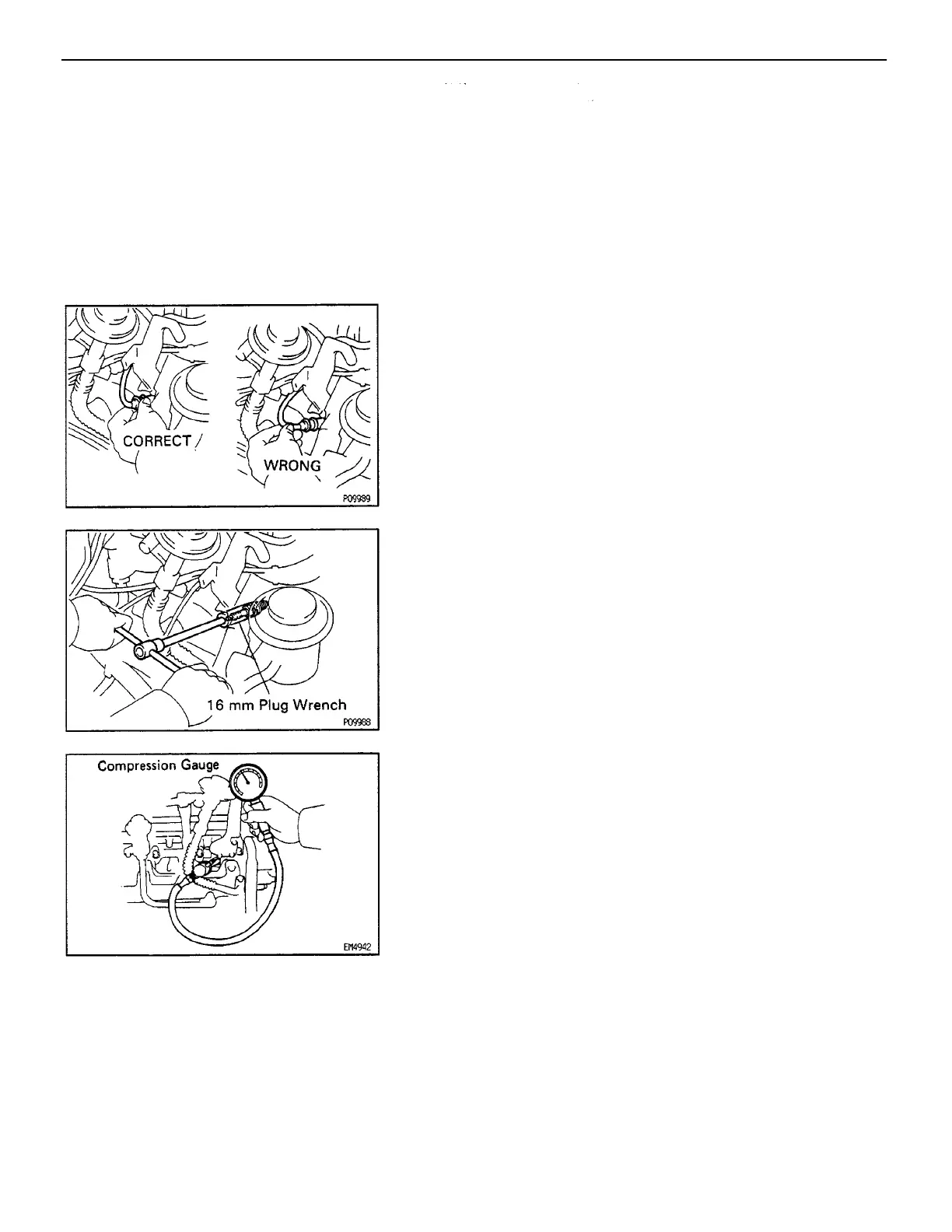
5. DISCONNECT HIGH–TENSION CORDS FROM
SPARK PLUGS
Disconnect the high – tension cords at the rubber
boot. Do not pull on the cords.
NOTICE: Pulling on or bending the cords may damage the
conductor inside.
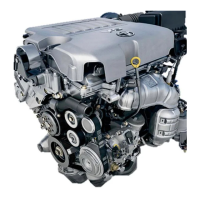
7. CHECK CYLINDER COMPRESSION PRESSURE
(a) Insert a compression gauge into the spark plug hole.
(b) Fully open the throttle.
(c) While cranking the engine, measure the compression
pressure.
HINT: Always use a fully charged battery to obtain
engine speed of 250 rpm or more.
(d) Repeat steps
(a) through
(c) for each cylinder.
NOTICE: This measurement must be done in as short a
time as possible.
Compression pressure:
1,177 kPa (12.0 kg f/cm
2
, 171 psi) .
Minimum pressure:
981 kPa (10.0 kg f/cm
2
, 142 psi)
Difference between each cylinder:
98 kPa (1.0 kg f/cm
2
, 14 psi) or less
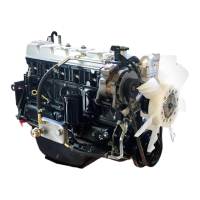
6. REMOVE SPARK PLUGS
Using a 16 mm plug wrench, remove the six spark
plugs.
–ENGINE ENGINE MECHANICAL
EG2–30


 To Next Page