9. Configuring the process controller
By means of the process controller, a process variable can be regulated, for instance the
pressure of a pump. The process controller is also referred to as "PID controller" (PID
controller = proportional, integral and differential controller).
The process controller is part of a closed control loop. The variable to be influenced
(controlled variable) is measured continuously by means of a sensor and supplied to the
inverter as an analog signal (actual value) which, in the inverter, is then compared to the
reference value (setpoint). The system deviation resulting therefrom is supplied to the
process controller which, on this basis, decelerates or accelerates the motor speed
according to the desired dynamic performance of the control loop, so that, for instance, a
pump always generates the desired pressure.
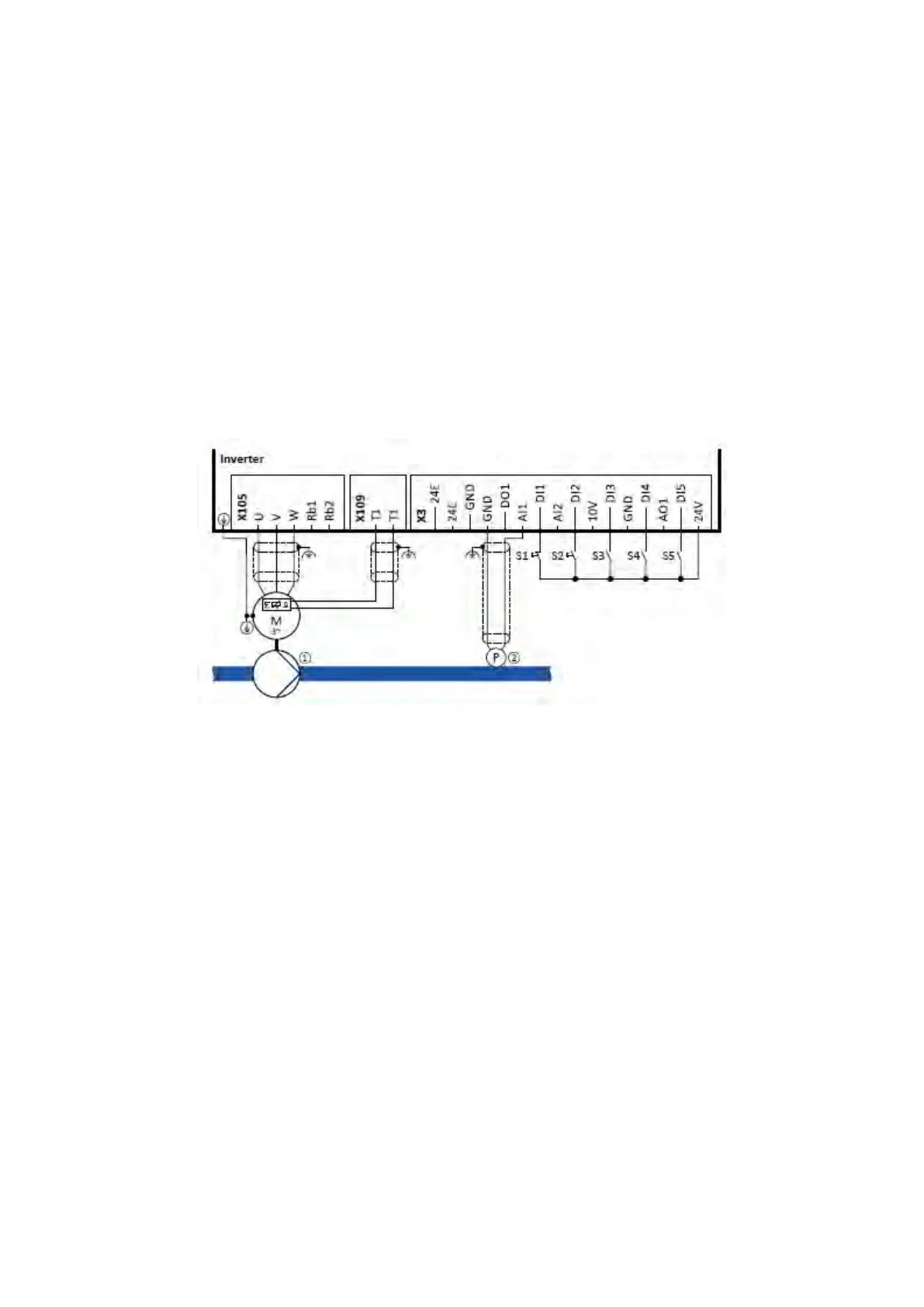
Connection plan (example)
The following sample connection plan shows the control of a pump
①
. The feedback of
the variable (here: pressure) takes place via a pressure transducer
②
connected to the
analog input 1.
The digital inputs can be used to activate functions of the process controller. The specific
assignment of the digital inputs and type of the contacts (switches or buttons, normally-
closed contacts or normally-open contacts) depends on the application.
General information on the setting
• The basic setting of the process controller is described in the following subchapter.
Basic process controller settings
233
• Optionally, the motor can be put into an energy-saving idle state if no power is
required.
Process controller idle state
239
• The rinsing function which can be activated in addition accelerates the motor in idle
state to a defined speed at regular intervals. The rinsing of a pipe system with a pump
that has been in an inactive state for a longer period is a typical application. Process
controller rinse function
240


 To Next Page