134 01-6203-01R3, CG Drives & Automation
7.2.2. Sensorless vector control (SLVC)
Sensorless (field-oriented) vector control for asynchronous motors is based on a
decoupled, separate control for the torque-producing and the field-producing current
component. In addition, the actual speed is reconstructed by means of a motor model so
that a speed sensor is not required.
Preconditions
• Sensorless vector control (SLVC) is only suitable for asynchronous motors.
• The sensorless vector control (SLVC) is possible up to a rated power of maximally 45
kW.
• Operation of the sensorless vector control (SLVC) is only permissible for one single
drive!
• Operation of the sensorless vector control (SLVC) is not permissible for hoists!
Supported operating modes 0x6060 (P301.00):
• "MS: Velocity mode [-2]"
• "MS: Torque mode [-1]"
• "CiA: Velocity mode [2]"
Details
This motor control type is activated by setting 0x2C00 (P300.00) = " Sensorless vector
control (SLVC) [4]".
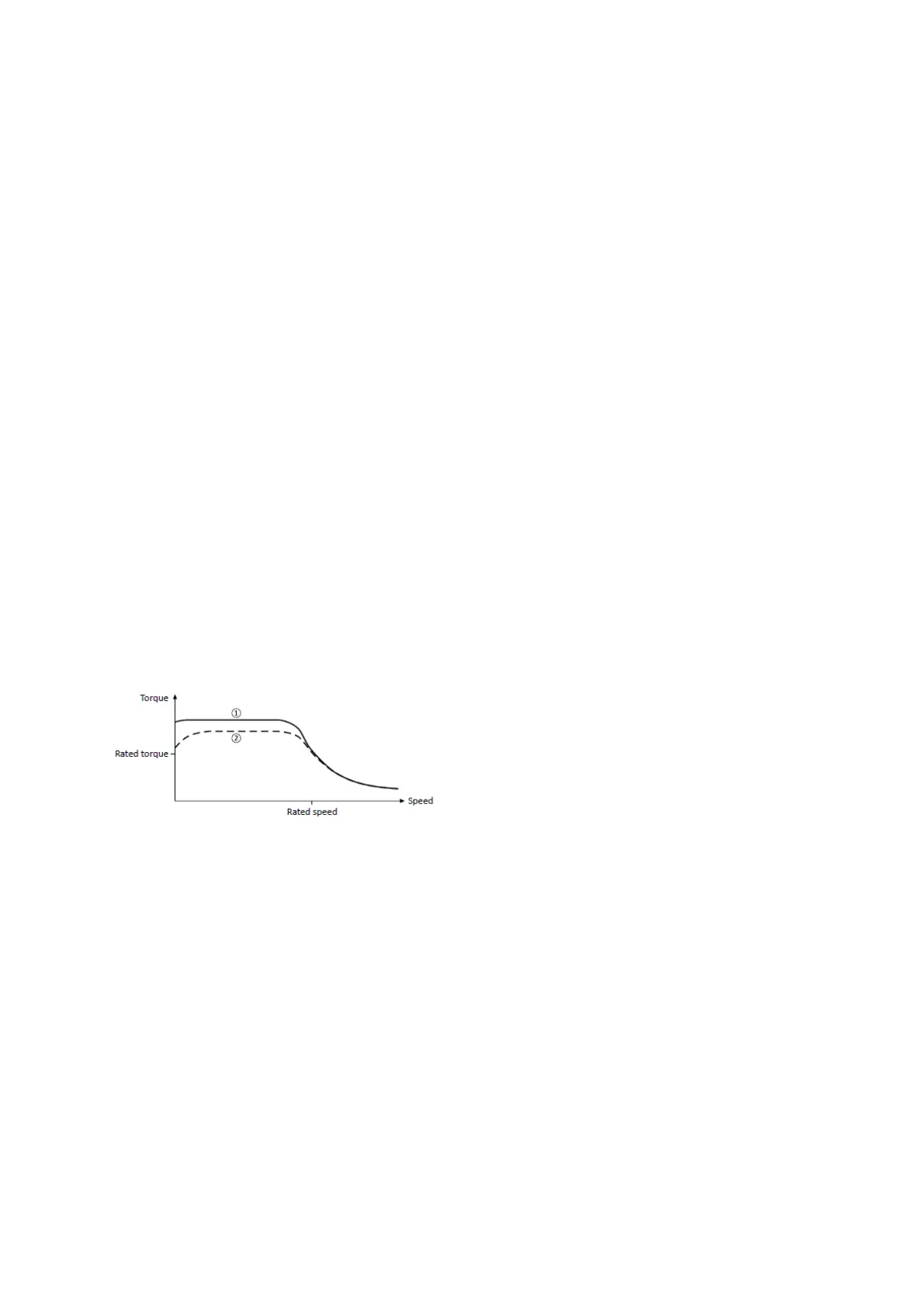
Compared to the V/f characteristics, the sensorless vector control (SLVC) serves to achieve
improved drive characteristics thanks to:
• higher torque throughout the entire speed range
• higher speed accuracy and higher concentricity factor
• higher efficiency
① Sensorless vector control (SLVC)
② V/f characteristic control (VFC)
137
For a speed control with torque limitation in operating mode 0x6060 (P301.00) = "MS:
Velocity mode [-2]":
1. Select the source in 0x2949:001 (P337.01) for the positive torque limit source and set
it accordingly.
2. Select the source in 0x2949:002 (P337.02) for the negative torque limit source and set
it accordingly.
Alternatively, the inverter can be configured in this motor control type in such a way that it
controls a motor torque within a defined frequency range. For details, see chapter "
Torque
control w/ freq. limit
".
147


 To Next Page