11. Sequencer
The "sequencer" function serves to transfer a programmed sequence of setpoints to the
motor control. The switch-over to the next setpoint can be made time-controlled or even-
controlled. Optionally, the "sequencer" function can also trigger the digital and analog
outputs.
The sequencer only generates setpoints. However, the sequencer does not
control the motor operation (does not output any start and stop
commands).
Basics: Sequences, steps and segments
• As a total, 8 sequences can be configured (with the numbers 1 to 8).
• Each sequence consists of 16 configurable steps.
• Each step of a sequence can call a "segment".
• A segment contains, among other things preset setpoints (speed setpoint, PID
control
value, torque setpoint), a combined acceleration/deceleration for the
speed setpoint and optionally a configuration for the digital and analog outputs.
• 8 different segments and one end segment can be configured.
• Alternatively to calling a single segment, a complete sequence (with a higher number)
can
also be called from one step. This serves to implement nested sequences or
summarise several sequences to one sequence.
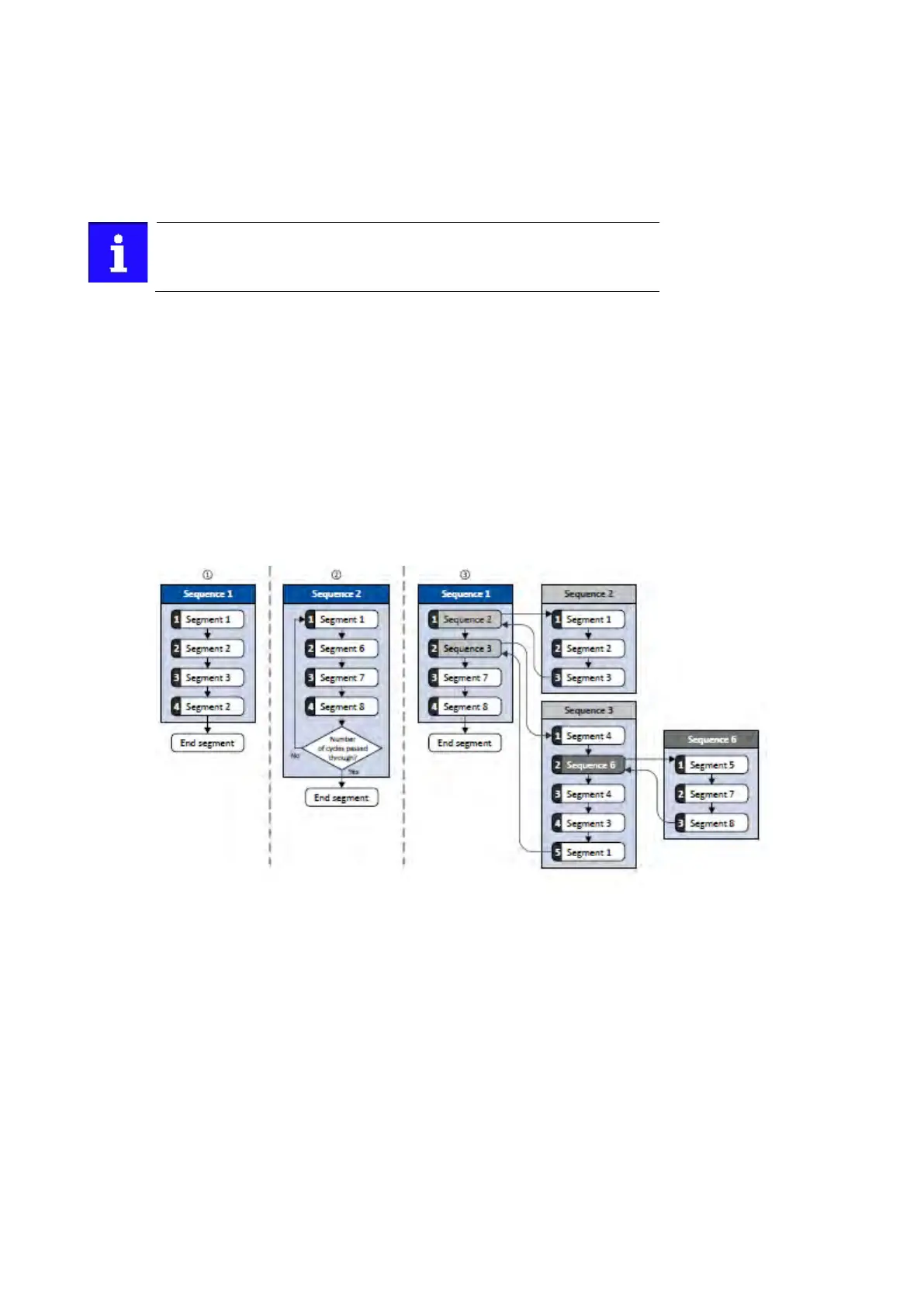
① Simple sequence with four steps.
② Simple sequence with four steps that are passed through several times (number of
cycles > 1).
For each sequence, the number of cycles can be set individually.
③ Nested sequence: Other (sub) sequences are called by one (main) sequence.


 To Next Page