RFL 9300 RFL Electronics Inc.
October 20, 2004 8 - 6 (973) 334-3100
8.2.3.1 FAMILIARIZATION
The following procedure prepares the RFL 9300 for the single-relay tests, and familiarizes you with RFL 9300
operation.
1. Make sure the power switch on the RFL 9300's power supply is in the off ("0") position.
2. Disconnect the BREAKER TRIP and DTT TRIP output circuits by disconnecting the wires from
rear-panel terminal blocks TB2 and TB3.
If the wires are not tagged, tag them as you remove them. This will make it easier
to reconnect them later.
3. Disconnect the communications link from the RFL 9300. On relays equipped with modems, re-
move all wires from the terminal block on the rear-panel of the line coupler I/O. On relays
equipped with direct digital, fiber optic, short haul fiber, or G.703 modules, unplug the connec-
tors.
If the communications lines are not tagged, tag them as you remove them. This
will make it easier to reconnect them later.
4. Connect the RFL 9300's transmit output to its receive input as follows:
Modem Versions:
Connect one end of a twisted pair to the terminal block on the rear panel of the
line coupler I/O, terminals 1 and 2. Connect the other end of the twisted pair to
terminals 3 and 4. These connections are not polarity sensitive.
Direct Digital Versions:
Connect an RFL DCE emulator, an RS-449 Cable assembly, and a loopback
connector to the direct digital interface module as shown in figure 8-1.
Fiber Optic Versions:
Connect a fiber optic patchcord between the fiber optic TX and RX connectors
on the rear panel.
Short Haul Fiber Versions:
Connect an RFL DCE emulator, a fiber service unit, an RS-449 Cable assem-
bly, a loopback connector, and two fiber optic cables to the short haul fiber in-
terface module as shown in figure 8-1.
G.703 Versions:
Remove the G.703 module from the 9300 and place the J5 jumper in the “loop”
position. Reinsert the G.703 module into the chassis and connect a loopback
connector to the G.703 module as described in paragraph 8.2.2, step 9. After
the completion of single-relay testing, move the J5 jumper back to the “normal”
position before placing the 9300 into service.
5. Place the power switch on the RFL 9300's power supply in the on ("1") position. Set the Trans-
mit Address of the unit to “0000”.
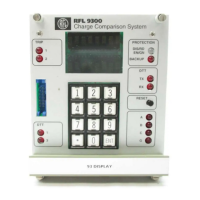
The three green indicators on the front of the power supply will light, and the RFL
9300 will start to initialize. After a few seconds, the green P-P and BER OK indica-
tors on the 93B CC module will light, and the PROTECTION indicator on the 93B
DISPLAY module will light green. A pair of dots will move across both lines of the
display, from left to right.
If the P-P and BER OK indicators fail to light, the RFL 9300's receiver may be
overdriven (modem or fiber optic versions) or the clock polarity may be wrong
(direct digital version). To correct, do the following:


 To Next Page