5
Figure 6. Dual-channel configuration (Analog, Digital, Fiber)
The relaying logic software for the modem version (3-pole) is
identical to the relaying logic for the wideband versions (Di-
rect Digital or Fiber Optics). The communications logic soft-
ware is similar, except the wideband versions send each mes-
sage three times consectutively, and two-out-ofthree voting
is done at the receiver terminal to enhance both security and
dependability. Since the relaying logic is the same, a field
upgrade from modem to wideband is easily accomplished.
RFL Electronics Inc. June 10, 2002
RFL 9300DCDR
Easy Upgrade from
“Voice Frequency to Digital”
Channel Delay Measurement
and Compensation
The RFL 9300 continually measures round-trip channel de-
lay time and automatically updates the channel delay com-
pensation. This channel delay compensation and the natu-
ral insensitivity of the charge comparison principle to time
delays, allows the RFL 9300 Digital Current Differential Re-
lay to tolerate “differential delays” and sudden delay transi-
tions better than other schemes. This is becoming highly
desirable with the application of switched ring topology PDH
and SDH or SONET systems which can introduce sudden
unpredictable delay transactions and or differential delays.
Redundant Communications
In case of channel failure, “hot standby communication” chan-
nels ensure continuity of current differential protection. There
are two different arrangements for two-terminal lines: single-
channel and dual-channel.
TWO-TERMINAL LINE, SINGLE CHANNEL
In the event of a channel failure in one direction, the terminal
receiving good information trips on charge comparison. The
terminal receiving corrupted information (or no information) trips
sequentially on loss-of-load. (This is one of the backup modes
described on page 9 of this Product Information Sheet.)
TWO-TERMINAL LINE, DUAL CHANNEL
Figure 6 shows a dual-channel configuration that includes a
hot-standby channel. This channel is switched intoservice if
the primary channel fails. This transfer does not occur dur-
ing a fault. Analog channels can not be combined with Digi-
tal or Fiber Channels in a Dual Configuration.
Figure 7. Three-Terminal Line Channel Configuration
(Analog, Digital, Fiber)
RFL 9300
RFL 9300
RFL 9300
THREE-TERMINAL LINE, SINGLE CHANNEL
Figure 7 shows a three-terminal single channel configuration. In
the event of a channel failure, the relay without a comms alarm has
sufficient information to send trip signals to the other two, under
fault conditions. Communication channel options VF Channel, 56/
64 Kbps RS-422, G.703, V.35, X.21 or direct fiber optics in a closed
delta path. Leased analog channels cannot be combined with digi-
tal, or fiber optic communication channels.
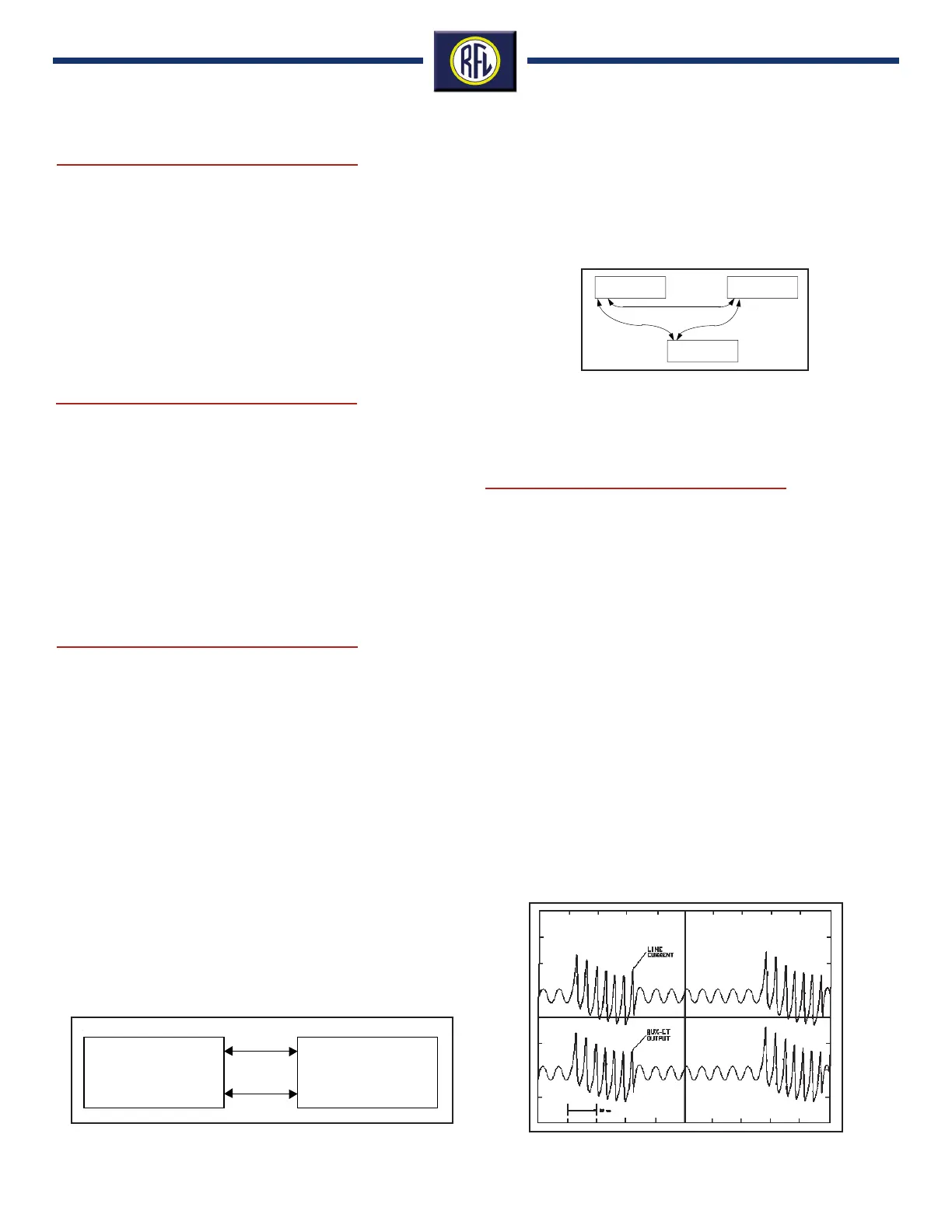
The phase and residual currents are applied to the RFL 9300
auxiliary current transformers (ACTs) operating at almost
zero flux. The ACTs are designed to virtually cancel the core
flux (U.S. Patent No. 5,150,270; foreign patents pending).
The RFL 9300’s ACTs provide several advantages over con-
ventional ACTs:
1. Very small core size.
2. Virtually no burden presented to the main current
transformers (CTs).
3. Totally free of saturation, even for full cur
rent offset and very long dc time constant.
This provides extremely high accuracy of transformation over
a very wide dynamic range. Figure 8 shows the ACT acting
as a “perfect” transformer, even when subjected to repeated
tests with the dc offset in the same direction.The ACT is
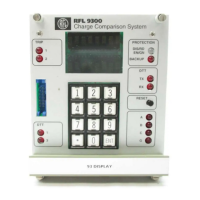
mounted on the ACT I/O Module, shown in Figure 9. A heavy-
duty terminal block is provided on the rear of this I/O module
for the main CT secondary current connections.
Flux-Cancellation Auxiliary
Current Transformer (ACT)
Figure 8. ACT test with full dc offset
RFL 9300
(3-pole)
RFL 9300
(3-pole)
Primary Channel
Backup Channel
RFL 9300
RFL 9300


 To Next Page