6
In some installations, it may be necessary to install the RFL
9300 relay in a different room, or building, than the commu-
nications equipment. To eliminate ground potential rise, and
induced voltage interference problems the RFL 9300 can
be configured with a Short Haul Fiber Optic Interface. This
interface provides a short fiber optic communications path
over a pair of dedicated 850 nm multimode fibers. A Fiber
Optic Service Unit, mounted at the communications equip-
ment converts the optical signals back into a standard RS-
422/ RS-449, V.35,X.21 or G.703 communications signal.
See Figure 10.This fiber service unit is compliant to the ANSI
C.37.94 specification.
Once connected, our non-proprietary software programming
language, Asynchronous Programming and Remote Inter-
rogation Language (APRIL), can be used to read settings,
re-program existing settings, or monitor relay target infor-
mation. A typical APRIL main menu is shown in Figure 11.
The RFL 9300’s RS-232 port may also be accessed by us-
ing the RFL 9660 Digital Switch. For more information about
this product, please contact RFL Electronics Inc.
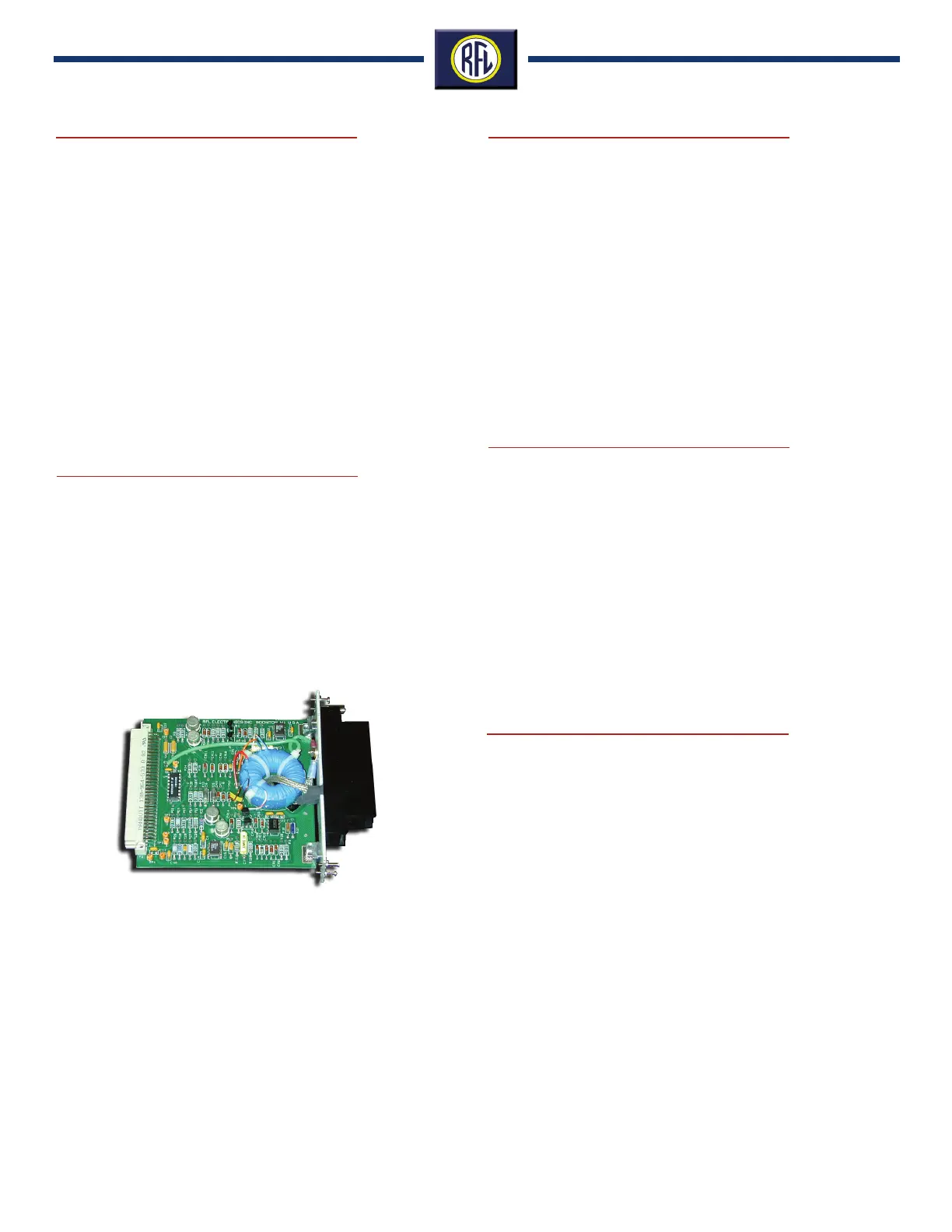
Figure 9. RFL 9300 ACT I/O module
A keypad and alphanumeric LED display are provided on
the RFL 9300’s display module. The operator uses the key-
board and display to read existing settings and measured
parameters. By entering a security code, settings can be
changed.
LED indicators on the Display Module serve as “targets” to
indicate RFL 9300 operations. Non-volatile memory retains
the status of these targets in the event of a dc power failure.
Remote interrogation is available through an RS-232 port on
the rear of the RFL 9300. This port can be connected to any
computer with a terminal emulation mode.
RFL Electronics Inc. June 10, 2002
RFL 9300DCDR
System Configuration
The RFL 9300’s completely modular design permits several
configuration choices. It can be equipped with a direct digital
interface, fiber optic modules, or modems for VF channel ap-
plications. The RFL 9300 can be configured to operate with 1
AMP or 5 AMP current transformers at line frequencies of
either 50 Hz or 60 Hz. For single-pole relaying applications
an optional 2 RU chassis is added to the existing RFL 9300.
The chassis provides six single-pole Form-A relays.
System configuration can be easily changed or confirmed by
viewing the jumpers on the RFL 9300 supervisor controller
module. These jumpers can be viewed by lowering the hinged
front panel. The available options are 1 AMP or 5 AMP sec-
ondary CT ratings, 50 Hz or 60 Hz system frequency, 2 ter-
minal or 3 terminal transmission line, and 3-pole or 1-pole
operation.
Operator Interface
Self-Monitoring
850nm Short Haul Fiber Interface
DC Trip Current Sense
The RFL 9300 continuously performs an 11-point bus test
and checks internal communications. It looks for charge dif-
ferences at trip levels without a resultant fault detector op-
eration. It also checks for abnormal channel behavior, in-
cluding high bit error rates, improper framing, and incorrect
received clock signals. Alarms are issued if a problem is
detected.
If a problem affects only one phase (or ground), the affected
subsystem is shut down, an alarm is issued, and the RFL
9300 operates on the remaining three subsystems. This ar-
rangement takes maximum advantage of the redundancy
that is inherent in the RFL 9300’s A/B/C/G configuration.
The TRIP (breaker trip) and DTT (direct transfer trip) tar-
gets only operate if dc trip current is sensed in the output
relay contact circuit(s). If the CS+TRIP trip release option
is selected, the current sense circuit seals in the CCS trip
output contact. The CCS trip contacts remain sealed until
the Phase Controlers rescind their trip signal(s) and the DC
trip curent is no longer sensed.
If either the TRIP+0 or TRIP+100 trip release options are
selected the current sense circuit does not seal-in the CCS
trip. Depending on which of these options is selected, the
Display Controller will release the trip signal either 0ms or
100ms after the Phase Controller trip signal(s) are no longer
detected.The DTT release is not programmable. The Dis-
play Controller holds a DTT for a minimum of 100ms after
the trip signal ends. The trip is then extednded beyond this
point only if the DTT DC trip current is still being sensed.


 To Next Page