8
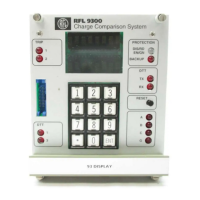
The RFL 9300 is fully modular, front and rear. This provides
increased reliability by completely eliminating chassis hand
wiring, and makes the RFL 9300 easier to troubleshoot. Spare
modules can be stocked instead of the complete relays.
MOUNTING
The 3 pole RFL 9300 is three rack-units high (5.25 inches, or
13.3 cm) and mounts in a standard 19-inch rack or cabinet.
The single pole RFL 9300 is five rack-units (8.75 inches, or
22.25 cm) (See Figure 13 for mounting dimensions)
WIRING
Rear views of the RFL 9300 showing terminal assignments
for typical systems are shown in Figure 14.
The RFL 9300 provides several auxiliary functions, in addition
to charge comparison:
ULTRA HIGH-SPEED (UHS) TRIPPING
The UHS signal has priority interrupt whenever the instanta-
neous current value rises to 170 percent of the nominal cur-
rent value, and lasts for 2 ms. A received UHS signal pro-
vides tripping; unless it is blocked by a local high current
value of opposite polarity.
WEAK FEED TRIP (WFT)
This is a logic circuit that looks for a combination of the following:
• A small local current (charge equivalent).
• A moderate or large current (charge equivalent) received
from the remote terminal.
An output from this circuit enables local tripping and sends
an “echo” permissive signal (called “WFT”) to enable trip-
ping at the remote (strong) terminal.
BI-DIRECTIONAL DIRECT TRANSFER TRIP (DTT)
DTT is a high priority signal. The charge comparison function is
restored quickly, after a brief interruption by DTT. The DTT sig-
nal is maintained with a “refresh” technique that is virtually trans-
parent to the charge comparison. This allows the DTT output to
follow the input without interfering with the line protection.
ADDRESSING
Each communication channel in the RFL 9300 is capable of
being assigned an unique address. There are 4,063 pos-
sible combinations.
FAULT DETECTOR SUPERVISION
Any sudden change in current (such as magnitude or half-
cycle duration) will operate a fault detector (FD). Additional
steady-state FD’s operate based on high current magnitude.
Security is enhanced by requiring that at least two Phase
Controllers within the system, including the Phase Control-
ler issuing the trip signal, have active fault detectors.
FUNCTIONAL TEST PANEL
The RFL 9300 can be supplied, mounted and wired to a three
rack unit functional test panel, part number 104700. The panel
is configured with ABB type FT-1 Current and Potential test
switches. This provides a convenient means for isolating the
relay inputs and outputs as well as measuring system cur-
rents during field testing and commissioning.
SEQUENCE-OF-EVENTS LOG
The RFL 9300 Sequence-of-Events Log maintains a list of
the last five alarm events and last five trip events. Both the alarm
RFL Electronics Inc. June 10, 2002
RFL 9300DCDR
Auxiliary Functions
and trip events are time tagged in hours, minutes, seconds
and milliseconds. The RFL 9300 contains a real-time bat-
tery backed clock, that is automatically synchronized to the
IRIG-B signal if it is available.
LOSS-OF-CHANNEL BACK-UP
The following four back-up modes are available:
1. High-Set Overcurrent (selectable option)
This uses separate phase and ground settings that are
independent of the charge comparison.
2. Inverse Time Overcurrent (selectable option)
When back-up protection is enabled, the RFL 9300 of-
fers eight totally independent phase and 3I
0
inverse time
overcurrent curves. Eleven different time dial settings are
also provided for each of the selected curves.
3. Loss-Of-Load
This provides sequential tripping for all internal faults ex-
cept three-phase; useful if the channel fails in one direc-
tion and not the other.
4. Switch-Into-Fault
This operates when the circuit breaker closes into a faulted line.
Fully Modular Construction
The RFL 9300 has the ability to synchronize its internal real-
time clock with an external IRIG-B clock source. The IRIG-B
signal enters the RFL 9300 through a BNC connector on the
Relay I/O module. The signal is then routed to the Oscillog-
raphy Board which demodulates the IRIG-B signal and feeds
it to an embedded controller which is also used for the oscil-
lography feature. The controller updates its battery operated
real-time clock based on the received IRIG-B signal. In the
absence of IRIG-B the APRIL setting of the display clock will
be used. The RFL 9300 can accept both modulated and
unmodulated IRIG-B signals.
IRIG-B


 To Next Page