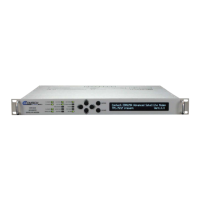
CDM-625 Advanced Satellite Modem Revision 13
Front Panel Operation MN-CDM625
5–47
• Selecting Rx-Sat-AIS as Active generates a fault whenever the demodulator senses that
the ‘all ones’ condition is present in the receive data.
• Typical for either, selecting AIS as Masked generates no alarms.
5.2.1.11.2 CONFIG: Mask Buffer or Ref
Buffer Slip Alarm = Active (Active,Mask)
Reference Alarms = Active ()
Use the
◄ ►arrow keys to select Buffer Slip Alarm or Reference Alarms, and then typical for
either use the
▲▼ arrow keys to select as Active or Masked. Press ENTER when done. Note the
following:
• Selecting the Buffer Slip Alarm as Active generates a Buffer Slip fault in the Rx faults
whenever the receive circuitry senses that the buffer is either underflowing or
overflowing.
5.2.1.11.3 CONFIG: Mask RxIF
RxIF Alarms: AGC=Active (Active,Mask)
EbNo=Masked ()
Use the
◄ ►arrow keys to select AGC or EbNo and then, typical for either, use the ▲▼ arrow
keys to select the alarms as Active or Masked. Press ENTER when done. Note the following:
• Selecting the AGC Rx IF Alarm as Active generates an AGC fault whenever the receive
signal level exceeds –20 dBm (for the desired carrier).
• Selecting the EbNo Rx IF Alarm as Active generates an Eb/No fault whenever the
demodulator sees the receive Eb/No fall below the pre-determined value.
• Typical for either, selecting the alarm as Masked, generates no alarms.
5.2.1.11.4 CONFIG: Mask TxClk
Tx Clock Alarm: = Masked (Active,Masked)
(Valid in G.703 & Ext clock modes) ()
Use the
◄ ►arrow keys to select the Tx Clock Alarm as Active or Masked, and then press
ENTER. Note the following:


 To Next Page