CDM-625 Advanced Satellite Modem Revision 13
Clock Modes and Drop and Insert (D&I) MN-CDM625
9–10
DDI
DDO
IDI
IDO
MODEM MODEM MODEM
Terrestrial Trunk
Multiple Modem Drop & Insert Application: This application shows how the loop is extended
to one or more additional modems.
DDO- IDI connection may be made internally using Loop = Y under D&I menu.
IDI
9.9 RX Buffer Clock = Insert (D&I only)
The E1 or T1 clock recovery from the IDI G.703 port serves as the RX Buffer reference. In
addition, the recovered data is the E1/T1 input to the Insert Mux. If the RX G.703 recovery
circuit detects no activity at IDI input, or cannot detect the expected frame format, Buffer Clock
= RX Satellite will be chosen as a fall-back.
If ‘Insert’ is not the selected buffer clock reference, the clock and data from the IDI port is
ignored, and a new E1/T1 frame is generated. The timeslots coming from the satellite are then
re-inserted into the selected timeslots of this new blank frame, and output on the IDO port.
9.10 Single-Source Multiple Modems
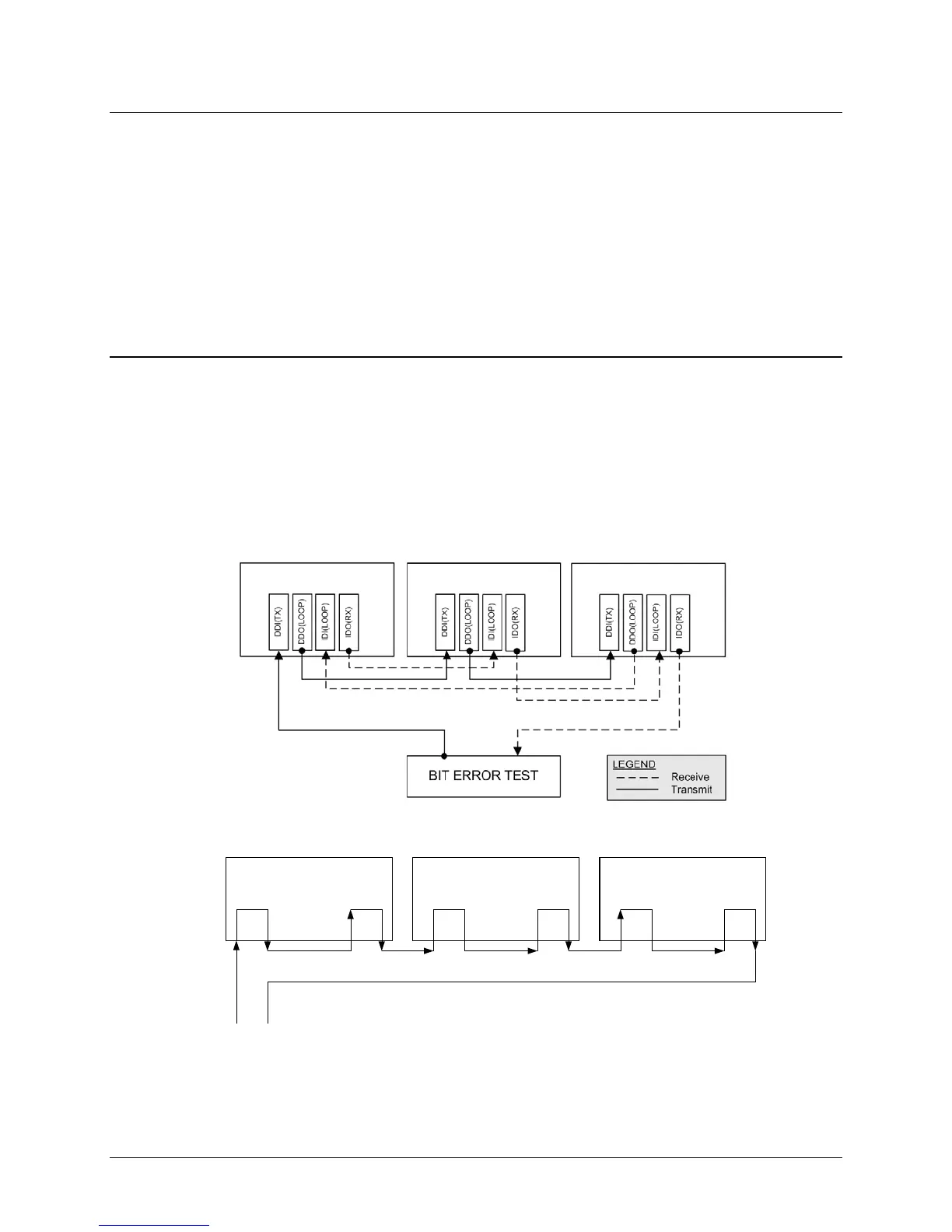
Two ways to connect a single T1 or E1 stream to several modems are by looming or daisy-chaining
modems. Looming method is illustrated in Figure 9-5, while Figure 9-6 illustrates the daisy-chain
method – each requires the RX Buffer Clock = Insert setting. Note the following:
• Assign all timeslots to not overlap.
• Assign modems to number of TX/RX channels as required.
Figure 9-5. Single-Source Multiple Modems (Looming)
Figure 9-6. Single-Source Multiple Modems (Daisy-chain)


 To Next Page