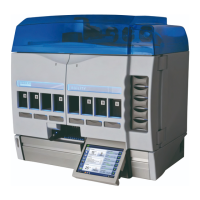
Steps in an Analysis
1.3 Steps in an Analysis
In a typical assay, the operations shown in Figure 1-2 are performed under computer control.
In some cases, two (or more) additional, incubation or wash cycles may be required for an
analytical procedure.
ADDITION OF
SAMPLES,
REAGENTS,
STANDARDS,
DILUENTS,
AND
CONTROLS
INCUBATION
WASHING
DETECTION
Figure 1-2 Operation Steps of the DSX™ Automated ELISA System
1 Addition of Samples, Reagents, Standards, Diluents and Controls to the
Plates
The automated pipette is used to withdraw the appropriate amount of sample,
reagent, standard, diluent or control from tubes (bottles) that are located in the
workspace and add the liquid to the appropriate wells. Pipetting is performed by
custom designed disposable pipette tips to assure pipetting precision and eliminate
the possibility of cross contamination.
All movement of the pipette tip, as well as replacement of pipette tips is performed
under computer control.
2 Incubation
Once the sample, reagents, diluents and standards have been added to each well,
the microplate is placed in an incubator module that is set to a specific temperature
(from 7 °C above ambient to 50 °C) for the appropriate period of time. If desired,
the microplate can be shaken during the incubation
3 Washing
After the incubation is complete, the microplate is moved to the wash module and
is washed. Eight wells of a microplate can be washed simultaneously, and different
wash cycles can be used on different columns on a microplate.
4 Detection and Calculation
The absorbance module measures the optical density of each sample, which is used
to calculate the concentration of the compound of interest in each sample on the
microplate. In addition, QC operations on raw data as well as curve fitting can be
performed to provide the desired results.
DSX™ System Service Manual 1-3


 To Next Page