GUIDA ALLA
PROGRAMMAZIONE
SINUS PENTA
359/486
39.1.2. TORQUE LIMIT AND FREQUENCY INCREASE DUE TO
OVERVOLTAGE – SVC (SMART VOLTAGE CONTROL)
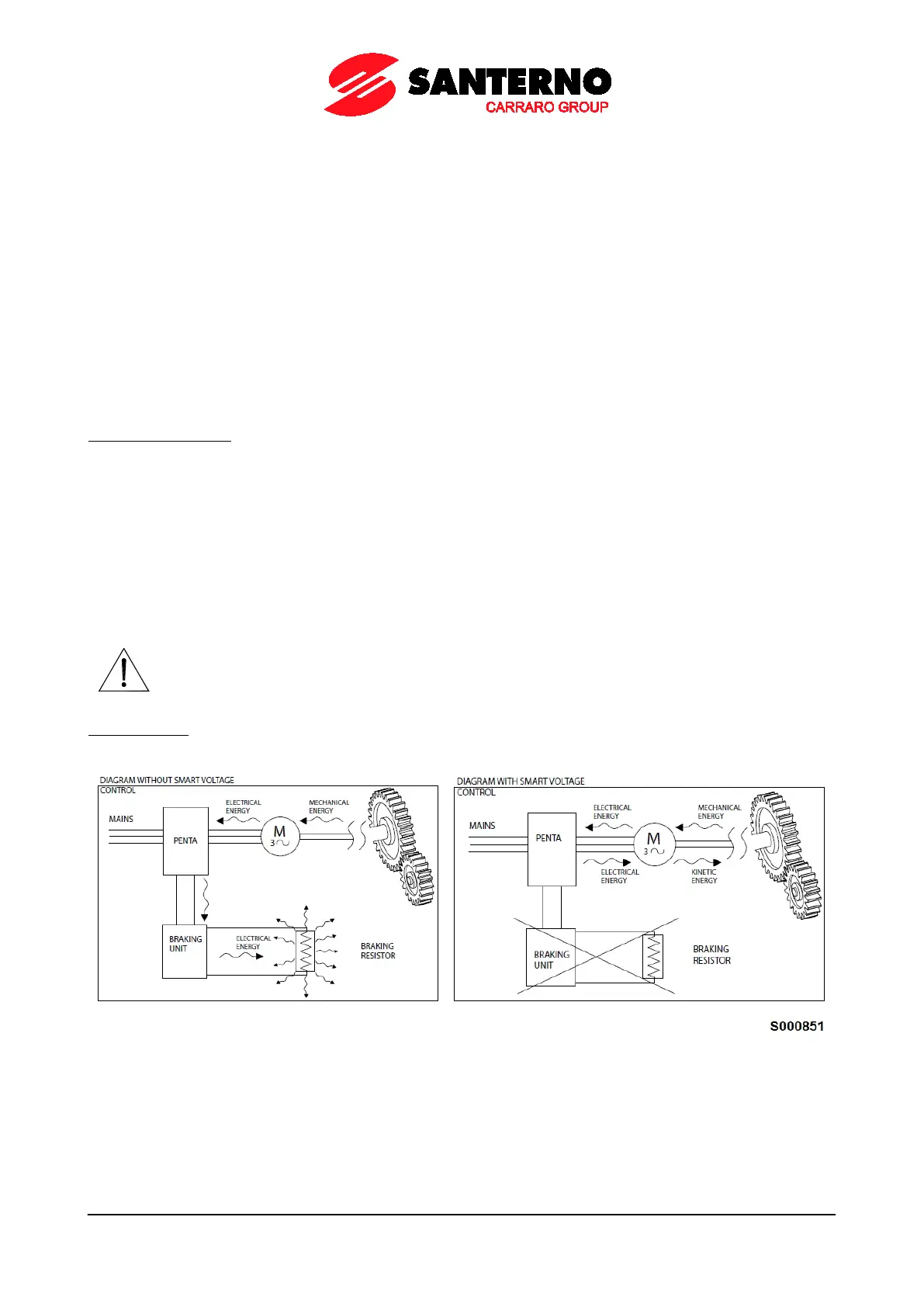
When voltage increases due to sudden load variations, the motor operates out of the regeneration range. The
mechanical energy regenerated during the negative torque transient is maintained in the drive-motor unit.
Applications
This control method may be used for applications characterized by:
• sudden variations of the load:
- Olive presses, mills,
- Rock grinders, waste grinders, etc.
• periodic work cycles also including regenerating negative torque areas:
- Pump jacks
- Excentric loads (presses)
- Crank systems
VTC and FOC controls: a special functionality is available, allowing reducing the resisting torque due to DC-bus voltage
increase, in order to prevent the Overvoltage alarm from tripping. A PI regulator is implemented to keep DC voltage
below a preset threshold, thus limiting the maximum value of the resisting torque. In FOC control, this function is
enabled only if C210=0. The regulator may be controlled in VTC control only. Parameters C213a and C213b are the
regulator’s proportional gain and integral gain respectively. Parameter C213c sets the voltage threshold, that equals:
Vth = C213c * Vunlock /100
where Vunlock depends on the drive voltage class and is typically higher than the voltage threshold activating the
braking resistor.
Parameter C213d enables reducing the rotor flux when the regulator activates, thus further limiting the DC voltage
increase.
CAUTION
The reduction of the resisting torque generated by the function above affects the speed
control when the motor accelerates due to external causes. Consequently, it can happen
that the motor accelerates and exceeds the maximum allowable value set in parameter
IFD control only: parameter C213 causes a step increase of the output frequency to limit the DC bus voltage increase
due to an abrupt change (decrease) of the motor load torque.
Figure 56: SVC (Smart Voltage Control)



 To Next Page