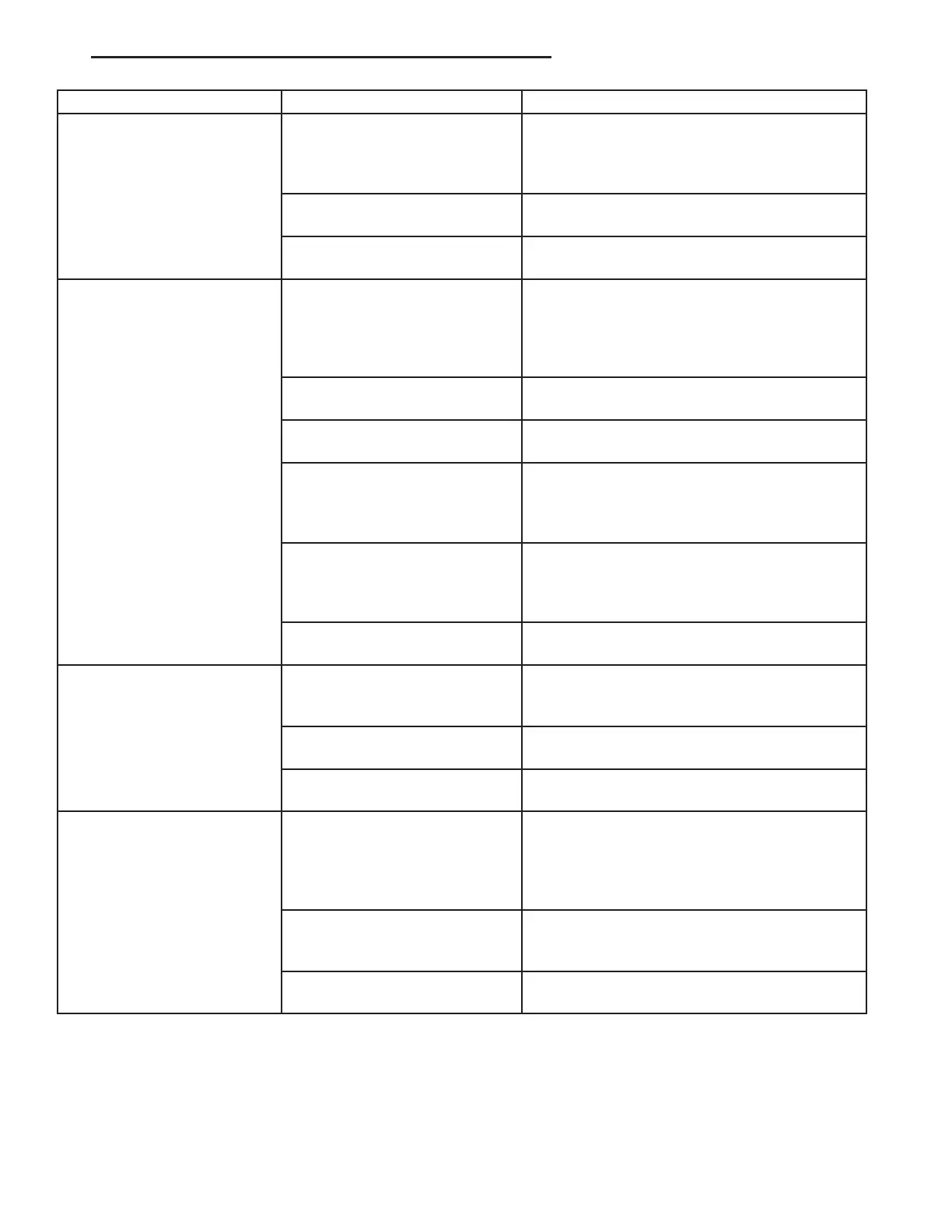
Condition Possible Causes Correction
The low side pressure is
normal or slightly low, and
the high side pressure is too
low.
1. Low refrigerant system
charge.
1. See Refrigerant System Leaks in this
group. Test the refrigerant system for leaks.
Repair, evacuate and charge the refrigerant
system, if required.
2. Refrigerant flow through the
A/C evaporator is restricted.
2. See A/C Evaporator in this group. Replace
the restricted A/C evaporator, if required.
3. Faulty A/C compressor. 3. See A/C Compressor in this group. Re-
place the A/C compressor, if required.
The low side pressure is
normal or slightly high, and
the high side pressure is too
high.
1. A/C condenser air flow re-
stricted.
1. Check the A/C condenser for damaged
fins, foreign objects obstructing air flow
through the condenser fins, and missing or
improperly installed air seals. Clean, repair, or
replace components as required.
2. Refrigerant flow through the
receiver/drier is restricted.
2. See Receiver/Drier in this group. Replace
the restricted receiver/drier, if required.
3. Inoperative radiator cooling
fan.
3. Test the radiator cooling fan and replace, if
required. Refer to Group 7 - Cooling.
4. Refrigerant system over-
charged.
4. See Refrigerant System Charge in this
group. Recover the refrigerant from the refrig-
erant system. Charge the refrigerant system
to the proper level, if required.
5. Air in the refrigerant system. 5. See Refrigerant System Leaks in this
group. Test the refrigerant system for leaks.
Repair, evacuate and charge the refrigerant
system, if required.
6. Engine overheating. 6. Test the engine cooling system and repair,
if required. Refer to Group 7 - Cooling.
The low side pressure is too
high, and the high side pres-
sure is too low.
1. Accessory drive belt slip-
ping.
1. Inspect the accessory drive belt condition
and tension. Repair as required. Refer to
Group 7 - Cooling.
2. Faulty A/C expansion valve. 2. See A/C Expansion Valve in this group.
Replace the valve, if required.
3. Faulty A/C compressor. 3. See A/C Compressor in this group. Re-
place the A/C compressor, if required.
The low side pressure is too
low, and the high side pres-
sure is too high.
1. Restricted refrigerant flow
through the refrigerant lines.
1. See Liquid Line, Suction Line and Dis-
charge Line in this group. Inspect the refriger-
ant lines for kinks, tight bends or improper
routing. Correct the routing or replace the re-
frigerant line, if required.
2. Restricted refrigerant flow
through the A/C expansion
valve.
2. See A/C Expansion Valve in this group.
Replace the valve, if required.
3. Restricted refrigerant flow
through the A/C condenser.
3. See A/C Condenser in this group. Replace
the restricted A/C condenser, if required.
HEA TER PERFORMANCE TEST
Before performin g the following tests, perform t he
ATC Fun ction Test using th e DRBIII! an d refer to
Coolin g for the procedu res t o check the ra diat or cool-
ant level, serpent ine dr ive belt tension, radiator air
flow and the radiator fan oper ation.
MAXIMUM HEATER OUTPUT
Engine coolant is pr ovided to the hea ter core
through a heater valve and heater hose. With the
engine idling at n ormal operat ing t empera ture, set
the h eater-A/C con trols as follows:
• Tempera ture control in the full hot posit ion
VA HEATING & AIR CONDITIONING 24 - 5









 To Next Page