ECM Control Strategy The engine control modu le
is involved wit h a variety of funct ions su ch a s: (Fig.
3)
• Individu al injector activa tion
• Engine idle speed control to ensure smooth
engine idling indepen den t of engine load
• Ride comfort function such as anti jerk control:
The CDI control modu le det ects irregularities in
engine speed (r esulting, for example, from load
changes or gear shift ) from the signal supplied by th e
crankshaft position sensor an d reduces them by
adju st ing th e quantity in ject ed int o each of the cylin-
ders
• Con st ant RPM (high idle fea ture) for am bula nce
vehicle bodies equ ipped wit h electr ical appliances
• Starter contr ol, immobilizer, cr uise control, kick
down, air condit ioner
• Ma int enan ce computer ASSYST (optional)
• Glow plug for pr e-heating, post heating a nd
inte rmitte nt he ating
• Error code mem ory/diagn ost ics, commu nica tion
interface for diagnosis an d handling the fault codes
• Th e ma xim um veh icle speed is progr amma ble
from 19–82 m.p.h. The standard is 82 m.p.h .
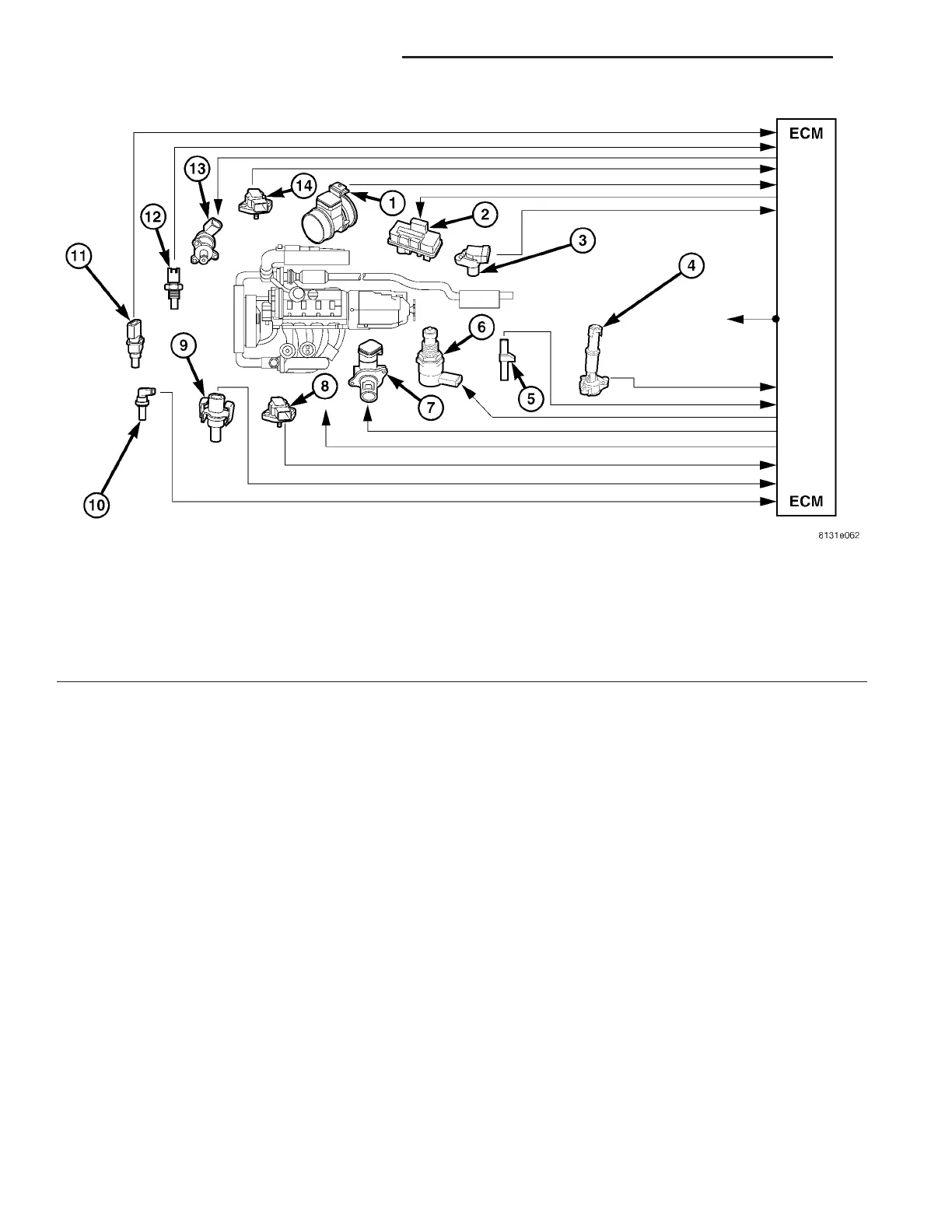
Fig. 2 ECM
1 - MASS AIR FLOW SENSOR 8 - CHARGE AIR PRESSURE SENSOR
2 - TURBOCHARGER SERVO MOTOR 9 - CHARGE AIR TEMPERATURE SENSOR
3 - CAMSHAFT POSITION SENSOR 10 - COOLANT TEMPERATURE SENSOR
4 - ENGINE OIL SENSOR 11 - FUEL RAIL PRESSURE SENSOR
5 - CRANKSHAFT POSITION SENSOR 12 - FUEL TEMPERATURE SENSOR
6 - PRESSURE REGULATOR VALVE 13 - FUEL QUANTITY CONTROL VALVE
7 - EGR VALVE 14 - AIR INTAKE PRESSURE SENSOR
8E - 4 ELECTRONIC CONTROL MODULES VA














 To Next Page