iPECS eMG80/100& eMG800 & UCP & vUCP
Administration and Programming Manual Issue 2.5
113
4.3.3.5 Station Class-of-Service – PGM 116
All stations are assigned a Class-of-Service (COS), which determines the ability of the user to dial certain
types of calls, refer to Table 3.3.3.5-1. Separate COS assignments are made for Day, Timed, and Night Mode
system operation. As a default, all stations are assigned with a Station COS of 1, with no restrictions for all
three modes. The station COS interacts with the CO Line COS to establish overall dialing or Toll restrictions.
This interaction and the resulting restrictions are given in Table 3.3.3.5-2.
Long-distance calls are determined by the 1st dialed digit (“0”) and/or the number of digits dialed. If the 1st
digit dialed is an LD code, default “0”, or, if the number of digits dialed exceeds the assigned LD digit counter
(SMDR Attributes PGM 177 button 4), the call is considering a Long Distance call, and appropriate restrictions
are applied.
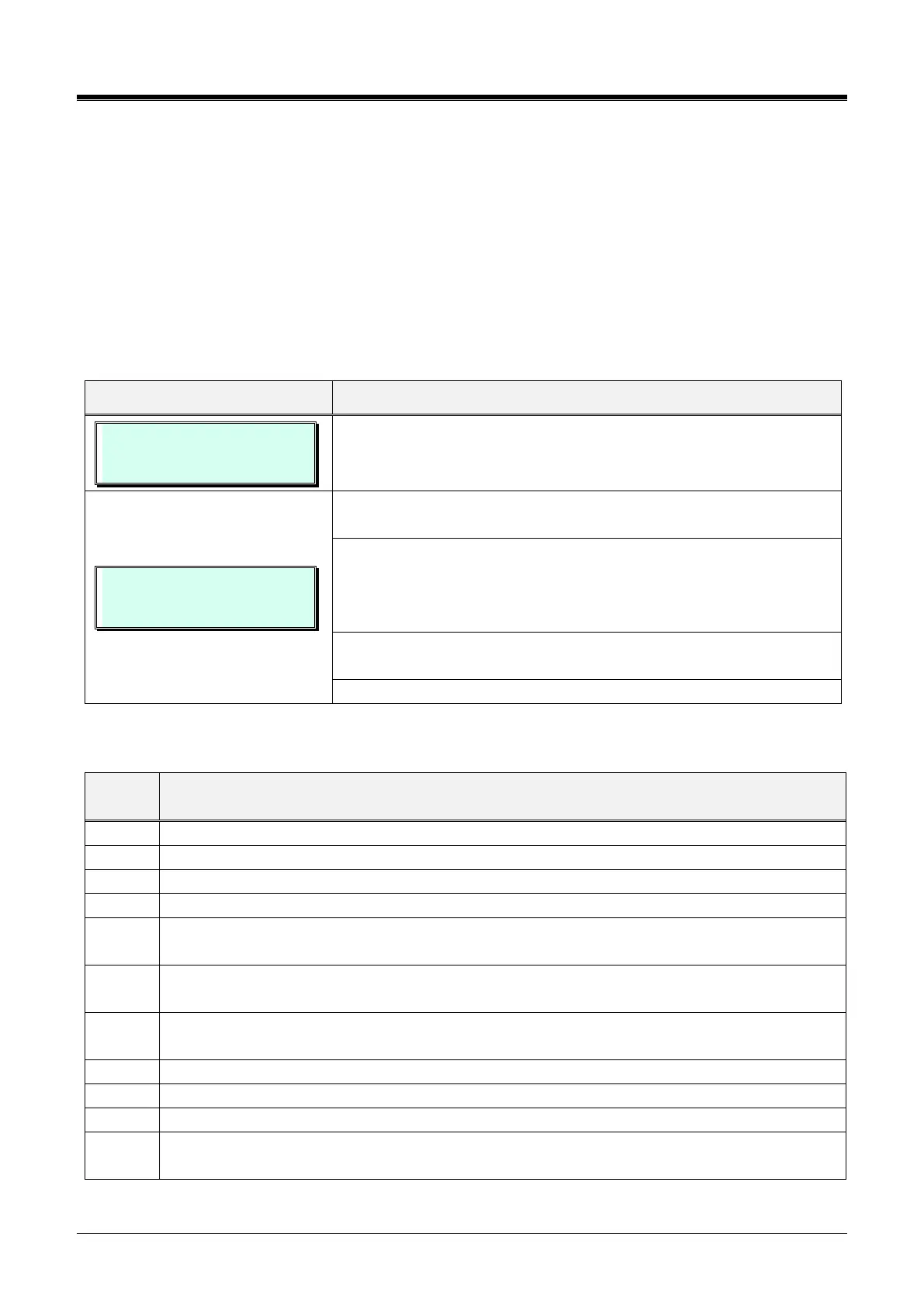
STATION COS
ENTER STA RANGE
Press the [PGM] button and dial 116.
100-110 STATION COS
DAY=01 NIGHT=01 TIMED=01
Use the dial-pad to enter a station range (Ex. 100~110). For a single
station, enter the same number twice.
Press desired Flex button,
- 1: Day mode COS
- 2: Night mode COS
- 3: Timed mode COS
Use the dial-pad to enter desired data for the Station COS. Refer to
Table 3.3.3.5-1 & Table 3.3.3.5-2.
Press the [Save] button to store the data entry.
Table 3.3.3.5-1 STATION CLASS-OF-SERVICE (PGM 116)
No restrictions are placed on dialing from the station.
The assignments in Exception Table A are monitored for allowing and deny numbers.
The assignments in Exception Table B are monitored for allowing and deny numbers.
The assignments in both Exception Tables A & B are monitored for allowing and deny numbers.
The leading digit dialed cannot be a Long Distance code, default “0”, and further denied/allowed
based on Exception Table C.
The leading digits dialed cannot be a Long Distance code & digit count cannot exceed the LD digit
counter, default 8 digits, and further denied/allowed based on Exception Table C.
Intercom and paging calls are allowed. No outgoing dialing except for emergency calls is allowed
on CO Lines.
The assignments in the Exception Table D are monitored for allowing and deny numbers.
The assignments in the Exception Table E are monitored for allowing and deny numbers.
The assignments in the Exception Table D & E are monitored for allowing and deny numbers.
The Exception Table A & B and D & E assignments are monitored for allowing and denying
numbers.



 To Next Page