(9) Verify repa ir.
PI ST ON S
DESCRIPTION
There a re several sizes and t ypes of pist ons used in
an automa tic transm ission. Som e pistons are used to
apply clu tches. They all have in common th e fact
that they are rou nd or circular in shape, located
with in a smooth wa lled cylinder, which is closed at
one end an d con vert s fluid pr essu re in to mechanica l
movem ent. The fluid pr essu re exer ted on th e pist on
is contained wit hin th e system through th e use of
piston rings or sea ls.
OPERATION
The principa l wh ich makes this oper ation possible
is kn own as Pascal’s Law. Pa sca l’s Law ca n be sta ted
as: “Pressure on a confined fluid is tr ansmitted
equally in all directions and acts with equa l for ce on
equ a l a r ea s.”
PRESSURE
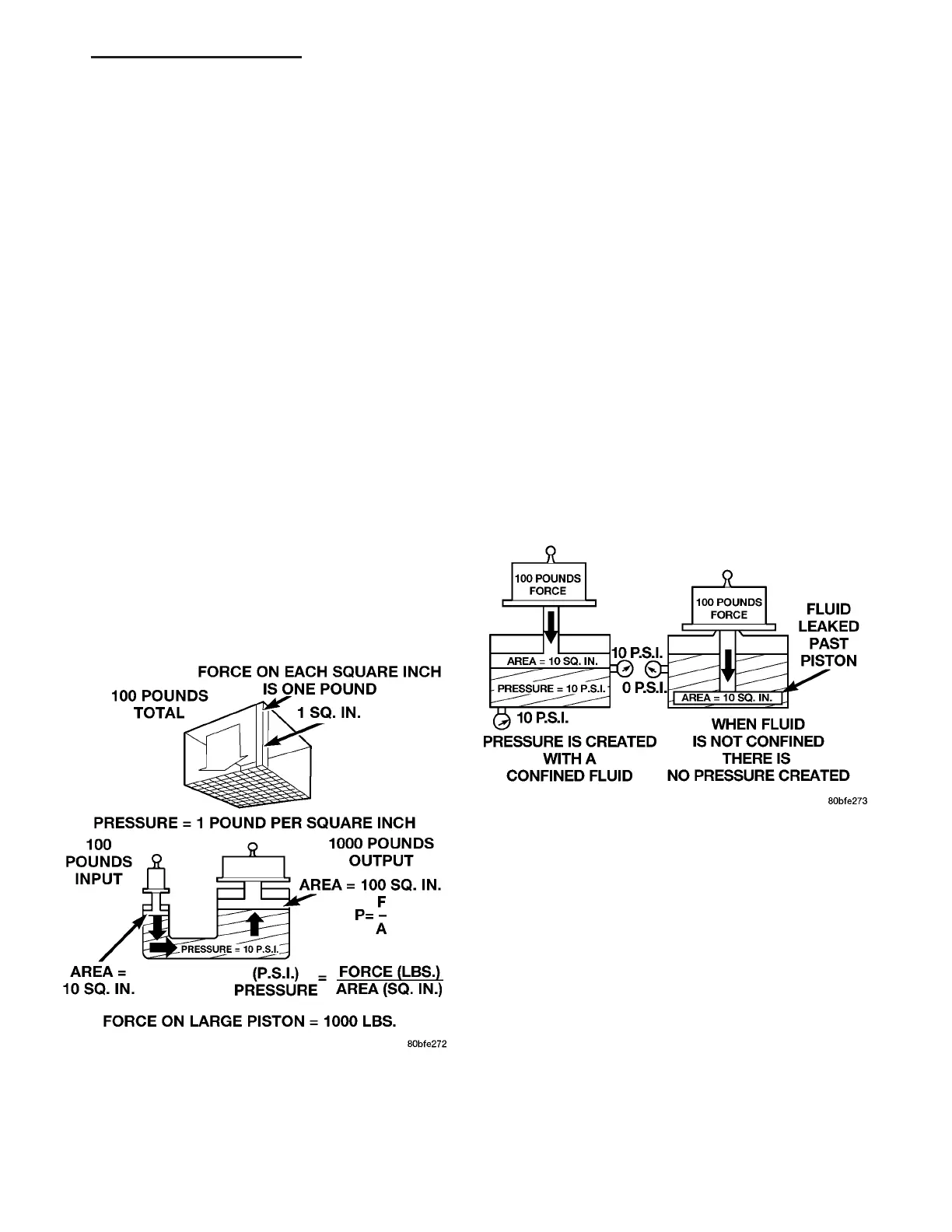
Pressur e (Fig. 213) is nothing more th an force
(lbs.) divided by area (in or ft.), or force per un it
area . Given a 100 lb. block and a n area of 100 sq. in.
on the floor, the pr essu re exert ed by the block is: 100
lbs. 100 in or 1 poun d per squa re inch, or PSI as it is
commonly referred t o.
PRESSURE ON A CONFINED FLUID
Pressur e is exer ted on a confined fluid (Fig. 214)
by applying a force to some given area in contact
with the flu id. A good example of t his is a cylinder
filled with fluid and equipped with a piston that is
closely fitt ed t o the cylinder wall. If a force is applied
to the piston, pressure will be developed in the fluid.
Of cour se, no pr essu re will be created if the fluid is
not confined. It will sim ply “leak” past t he pist on.
There must be a resistance to flow in order to crea te
pr essu re. Piston sealing is extremely import ant in
hydra ulic opera tion . Sever al kinds of seals are used
to a ccomplish this with in a tran smission. These
include but ar e not limited to O-rings, D-rings, lip
seals, sea lin g rings, or extremely close tolerances
between the pist on a nd the cylin der wa ll. The force
exerted is downwa rd (gravity), however, the principle
rema ins the same no m atter which direct ion is taken.
The pressur e creat ed in the fluid is equa l t o t he force
applied, divided by the piston area. If the force is 100
lbs., and the piston ar ea is 10 sq. in., then t he pres-
su re cr eated equa ls 10 PSI. Anot her inter pr etat ion of
Pascal’s Law is that regardless of conta iner sh ape or
size, t he pressure will be m ain tained throughou t, as
long as the fluid is confined. In other words, th e
pr essu re in the fluid is the sa me everywher e within
the con tainer.
FORCE MULTIPLICATION
Usin g the 10 PSI example used in t he illustration
(Fig. 215), a force of 1000 lbs. can be moved with a
force of on ly 100 lbs. Th e secret of for ce multiplica-
tion in hydraulic system s is the tot al flu id con tact
area employed. The illustr ation, (Fig. 215), sh ows an
area that is ten times lar ger tha n the original area .
The pressure cr eated with the smaller 100 lb. input
is 10 PSI. The con cept “pr essu re is the same every-
wh er e” m ea n s t h a t t h e pr ess u r e u n der n ea t h t h e
lar ger piston is a lso 10 PSI. Pressur e is equal t o the
force a pplied divided by th e cont act ar ea. Therefor e,
by means of simple algebra , t he output force ma y be
found. This concept is extremely import ant , as it is
also used in the design an d opera tion of a ll shift
valves and limiting va lves in th e va lve body, as well
as the pistons, of th e tr ansmission, which activate
Fig. 213 Force and Pressure Relationship
Fig. 214 Pressure on a Confined Fluid
VA AUTOMATIC TRANSMISSION NAG1 - SERVICE INFORMATION 21 - 163















 To Next Page