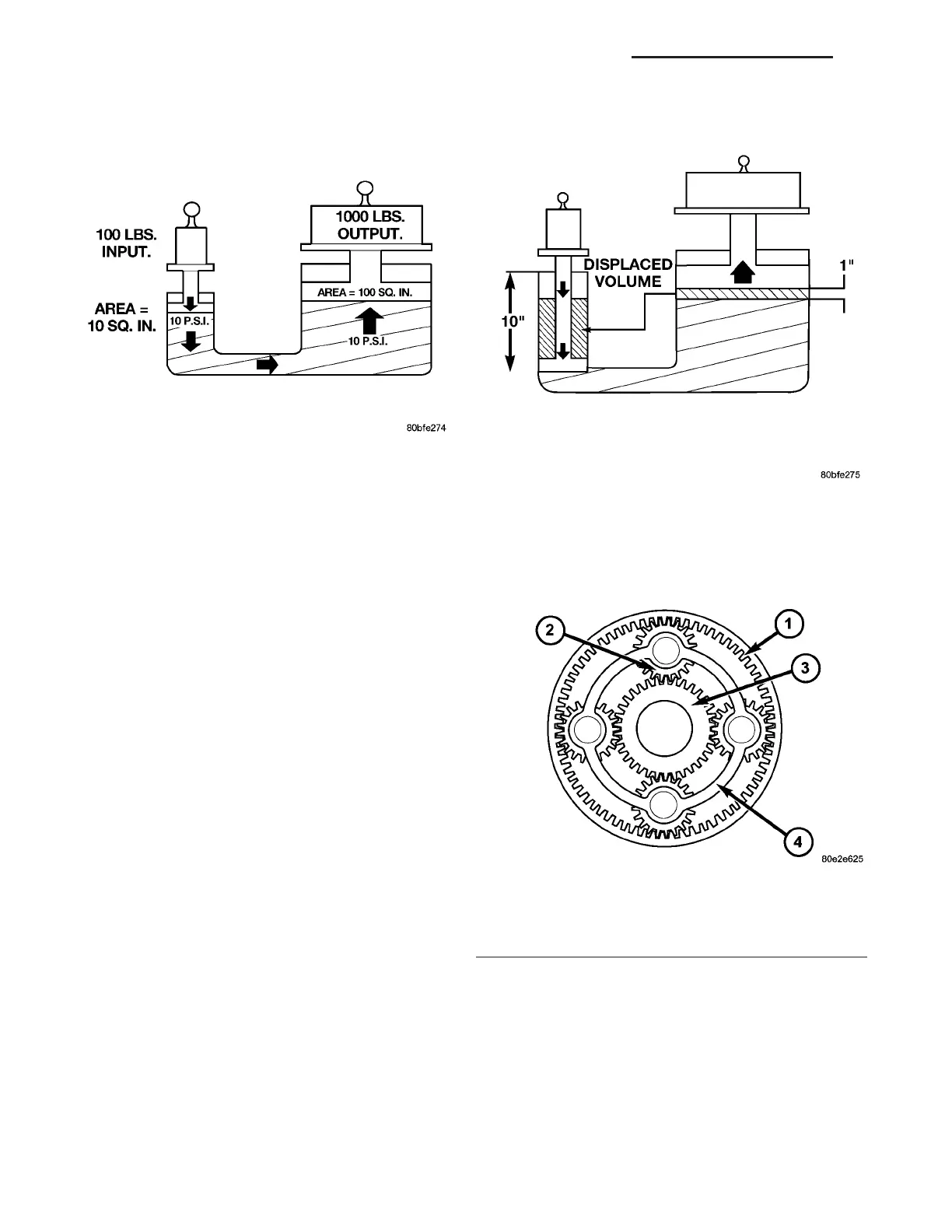
the clu tches and bands. It is n othing m ore tha n
using a difference of a rea to crea te a difference in
pr essu re to move an object.
PISTON TRAVEL
The r elat ionship between hydra ulic lever and a
mecha nica l lever is the sa me. With a mech anical
lever it’s a weight-t o-distan ce ou tput rather than a
pr essu re-to-a rea output . Usin g the sam e for ces an d
area s a s in the pr evious exa mple, t he smaller pist on
(Fig. 216) h as t o move ten times the dista nce
required to move th e la rger piston one inch. There-
fore, for every inch the larger piston moves, th e
sm aller pist on moves ten inches. This principle is
true in ot her instances also. A common gar age floor
jack is a good exa mple. To ra ise a car weigh ing 2000
lbs., a n effor t of on ly 100 lbs. ma y be requir ed. For
every in ch the car moves upward, the input piston at
the jack ha ndle m ust move 20 in ches downwa rd.
PLAN ETARY GEART RAI N
DESCRIPTION
Three planet ary gear sets (Fig. 217) are used to
pr odu ce the differen t gear r atios. These are located
in the mecha nica l part of the tr ansmission as th e
front, middle and rear planetary gear sets.
Fig. 215 Force Multiplication
Fig. 216 Piston Travel
Fig. 217 Planetary Geartrain
1 - ANNULUS GEAR
2 - PLANETARY PINION GEARS
3 - SUN GEAR
4 - PLANETARY CARRIER
21 - 164 AUTOMATIC TRANSMISSION NAG1 - SERVICE INFORMATION VA















 To Next Page