iPECS eMG80/100& eMG800 & UCP & vUCP
Administration and Programming Manual Issue 2.5
265
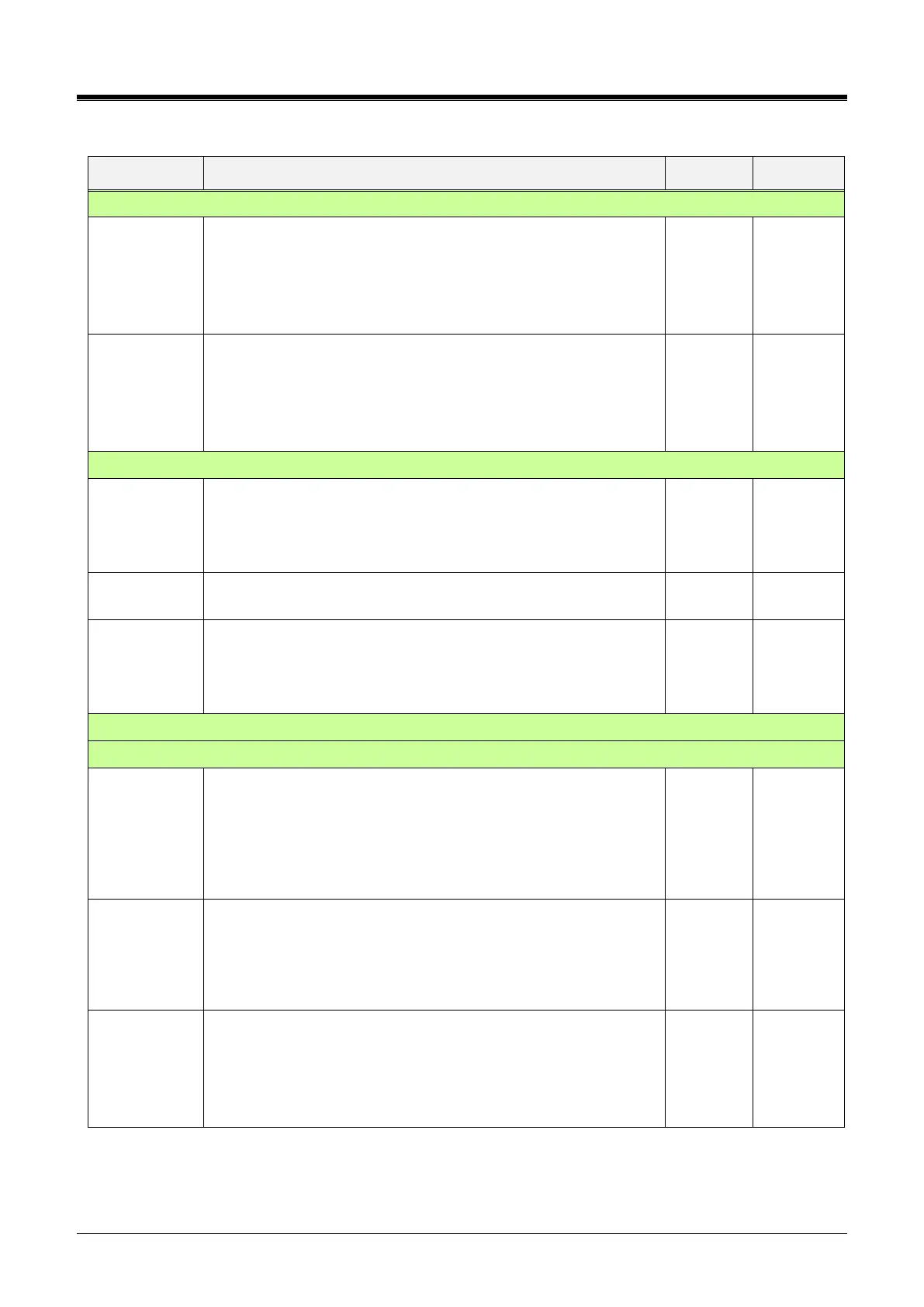
Table 4.4.8.3-1 SIP CO ATTRIBUTES
SIP Call Setup Failover Option
When the system initiates a SIP Trunk call and receives no
response from the SIP proxy server, after the expiration of this
timer, the SIP call is canceled, and a Fail-over call is placed on
the Fail-over CO/IP Line group specified below. Note the timer
can be set at 3 to 15 seconds and ‘0’, which disables Fail-over.
When the system attempts to initiate a SIP Trunk call and the SIP
Trunk is in an OOS state, or the SIP proxy server does not
respond in the No Response time above, the system will cancel
the SIP call and place a call over a CO/IP Line from this group.
eMG80/100:1 ~ 21, eMG800/UCP:1~201
During a SIP call or “session,” there are no signaling packets sent
or received from the SIP Call server. In order to assure a session
is still active, the system can periodically send an Option message
that the SIP Call server should acknowledge.
When “Session Timer Usage” is enabled, the system will verify the
session at this timer interval.
During the negotiation with “Session Timer Usage” enabled, the
system will use this value as the minimum Session expiration
timer and will not respond to a SIP Options message prior to the
expiration of this timer.
The SIP “To:” header is formatted using the SIP or Telephony
method, as shown below.
SIP method
To: < sip:[Number]@[Domain];user=phone >
Telephony method
To: < tel:+[Number] >Domain
When assigned the Telephony method for the “To” header, the
number format can be:
Local - [tel:+Number]@[Domain]
Global(+E164) - [tel:+E.164 Address]@[Domain]
E.164 Address: Nation + Area Code + Number
The Area code (PGM 143) can be added as a prefix if the
‘Numbering Format’ is set as Local.
Example:
user dials ‘8701234’ and the Area code is ‘042.’
The resulting “To” field URI is tel:+0428701234@[Domain]



 To Next Page