Call routing
226
System functions and features as of R4.1
syd-0570/1.2 – R4.1 – 08.2016
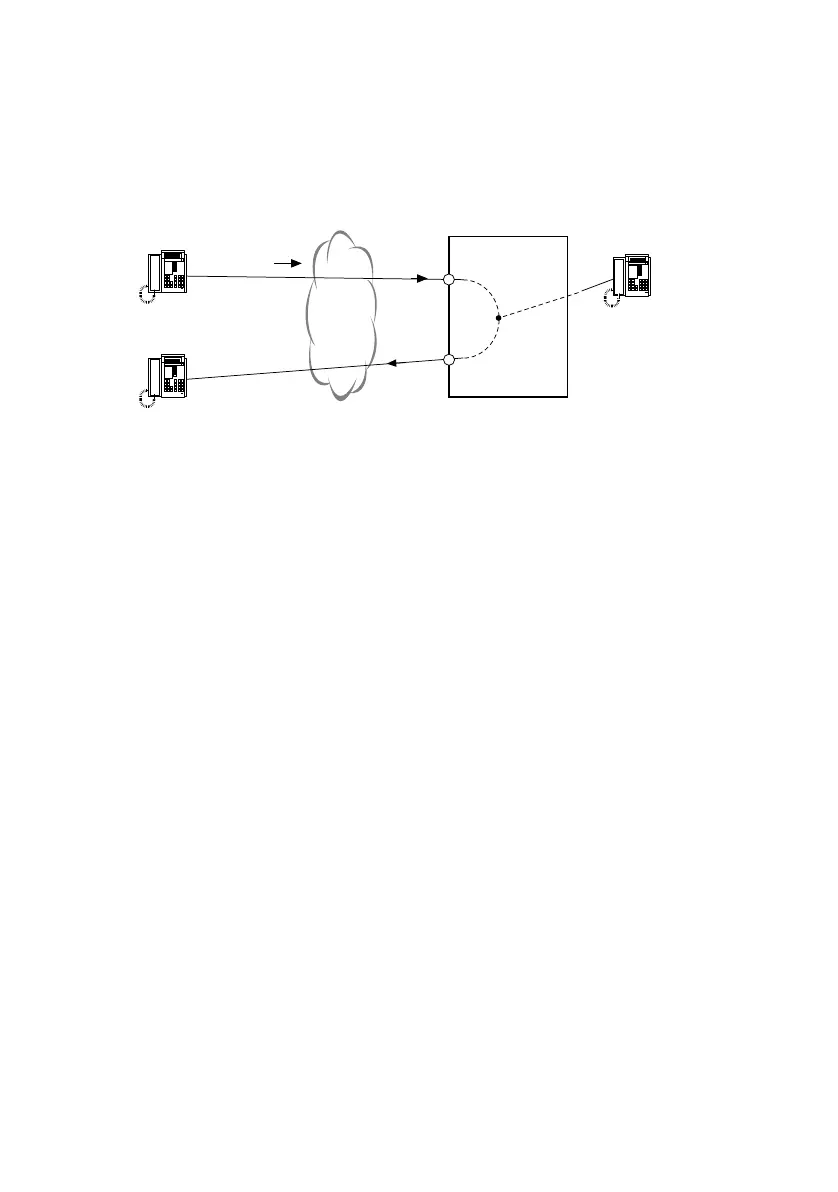
6. 6. 1. 1 Setting up Exchange-to-Exchange Connections
An exchange-to-exchange connection can be set up using Call Forwarding Uncondi-
tional, Conference, Call Forwarding on No Reply, Call Deflection and Transfer with or
without prior notice.
V Transfer
C Conference
CFU Call Forwarding Unconditional
CFNR Call Forwarding on No Reply
CD Call Deflection
Fig. 108 Exchange-to-Exchange Connection
6. 6. 1. 2 Clearing down Exchange-to-Exchange Connec-
tions
Digital to digital:
The public network sends the communication server a release signal once the external
call partners of an exchange-to-exchange connection have finished the call. The con-
nection can then be cleared down by the communication server.
Without a release signal, the communication server cannot clear down an exchange-
to-exchange connection.
The amount of time between completion of the call and the sending of the release sig-
nal depends on whether the exchange-to-exchange connection is set up end-to-end
within the ISDN network (end-to-end ISDN connection) or whether sections of it are an-
alogue (non-end-to-end ISDN connection).
At transitions to other networks (for example from leased-line-network to mobile phone
network) it is possible, due to the lack of correct signalling, that an end-to-end ISDN
connection is signalled as a non-end-to-end connection.
624 2x xx
624 22 02
202
C
A
624 45 67
647 22 16
624 22 02
B
CFU
Communication
server
T, C,
CFNR,
CD


 To Next Page