Features
392
System functions and features as of R4.1
syd-0570/1.2 – R4.1 – 08.2016
9. 6. 6 Silent intrusion
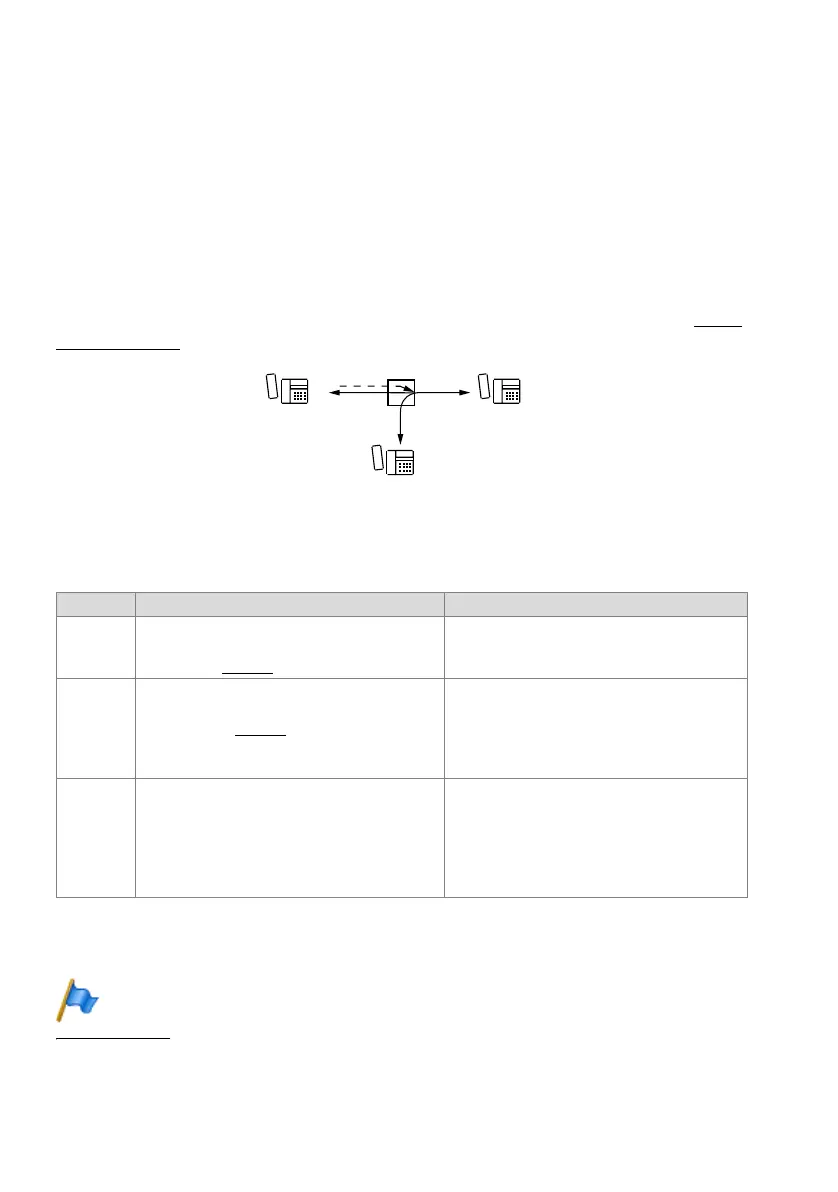
Silent intrusion is a variant of the Intrusion feature and is used primarily in call centres.
If the called internal user B is busy, the calling internal user C has the possibility of in-
truding into the current call without call parties A and B being aware of it. Unlike with
the Intrusion feature, user B is signalled neither visually nor acoustically and thus can-
not reject Silent intrusion. User C listens to the ongoing call. His microphone remains
switched off.
User C can now enable his microphone or press the Intrusion key at any time to intrude
into the call
1)
. Normal Intrusion with signalling is then carried out as described in "Intru-
sion", page 390.
Fig. 214 Silent intrusion
Detailed Description
Tab. 199 Silent intrusion
If B is making an exchange all, Silent intrusion will only work if this feature is also ena-
bled for exchange calls, throughout the system.
Notes:
– In connection with the Silent intrusion feature, relevant national data protection regulations
must be observed.
1) Supported only for system phones of the MiVoice 5300, MiVoice 5300 IP, Mitel 600 DECT and
MiVoice2380IP series
End point Operating sequence / signalling on terminal Scope
A Basically no signalling. Depending on the connec-
tion type, user A can hear a crackling when C
intrudes (see Tab. 200
).
B Basically no signalling. Depending on the connec-
tion type, user B can hear a crackling sound when
C intrudes (see Tab. 200
).
Requirement:
• B has allowed intrusion on his set.
• B is not an Mitel SIP or SIP terminal.
• B is not in the process of setting up a call, in an
enquiry call or in a conference.
C C hears a busy tone if intrusion is not allowed or is
not available
Possible interfaces:
• Internal
Requirements:
• C has the authorization for silent intrusion.
• C is not an ISDN Mitel SIP or SIP terminal.
• A Silent Intrusion licence is in place.
&
$


 To Next Page