Numbering plan
61
System functions and features as of R4.1
syd-0570/1.2 – R4.1 – 08.2016
3. 2. 5 Category for users
3. 2. 5. 1 Internal users
The call numbers within this category are assigned one or more terminals. The follow-
ing terminal types are supported:
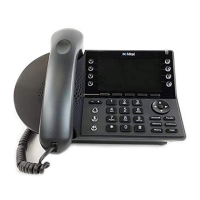
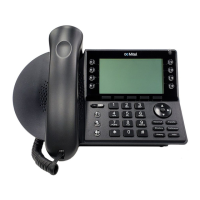
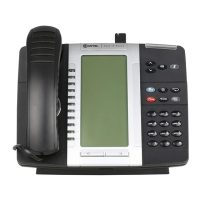
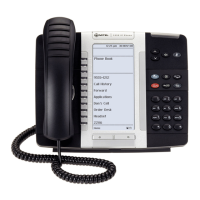
• IP system phones (hardphones and softphones)
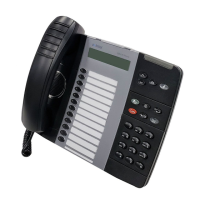
• Digital system phones (DSI / DASL)
• Cordless DECT phones (system phones or GAP phones)
• Analogue terminals
• SIP system phones (Mitel SIP)
• SIP phones or SIP terminals by other manufacturers (standard SIP)
• BluStar phones (hardphones and softphones)
• Integrated mobile/external phones (with assigned internal call numbers for incoming
and outgoing calls; see "Integrating mobile and external phones", page 61
.)
• Integrated mobile phones with user-friendly Mitel Mobile Client application (linked to
the communication server via an MMC Controller).
• Virtual phones (behave like analogue internal phones, except that they do not oc-
cupy any port since no hardware is available; see "Virtual terminals", page 65
.)
• ISDN terminals on the BRI-S bus (phones, PC cards)
If an internal user is assigned a name, the user in question can be dialled internally by
entering the name instead of the call number (dialling by name), and the name is dis-
played on the destination user’s terminal on the system’s own communication server,
or another PINX in the PISN (CNIP).
3. 2. 5. 2 Integrating mobile and external phones
Although the communication server does not have a GSM receiver, mobile phones can
be connected to MiVoice Office 400. The mobile phone is assigned to a user and can
be reached internally using his user number. If the mobile phone user dials a call num-
ber specially set up in the communication server, he can execute certain functions via
*/# function codes or make internal/external calls. This feature is not limited to mobile
phones, but can also be used for other external phones.
An in-depth integration is achieved through the Mitel Mobile Client application installed
on a mobile phone, as well as with the help of an MMC Controller connected to the
communication server. The Mitel Mobile Client allows the most important telephony
functions to be used conveniently, whereas the MMC Controller enables mobile users,


 To Next Page