Atmospheric Pre-aligner Manual
4000-0015 Rev 1
47
Vacuum Valve Sensor
The Vacuum Sensor indicates the presence or absence of a wafer on the
chuck. A sensor switch prevents a signal from being sent to the controller
until the magnitude pressure of the vacuum has crossed a preset threshold
setting. The vacuum sensor is preset at a level that works correctly and
accurately; it is preset to -8 in Hg (27091 Pa).
The vacuum sensor has the following characteristics:
• Functions within a pressure range from 0 to –30 in Hg (0 to 101592
Pa).
• Has a pressure set-point hysteresis of +/-3% over the full pressure
range. The drift of the threshold setting over time does not exceed this
hysterisis.
• Performs to a full-scale accuracy of +/-3% from 40 to 100
o
F and +/-5%
outside of those temperature parameters from 32 to 140
o
F.
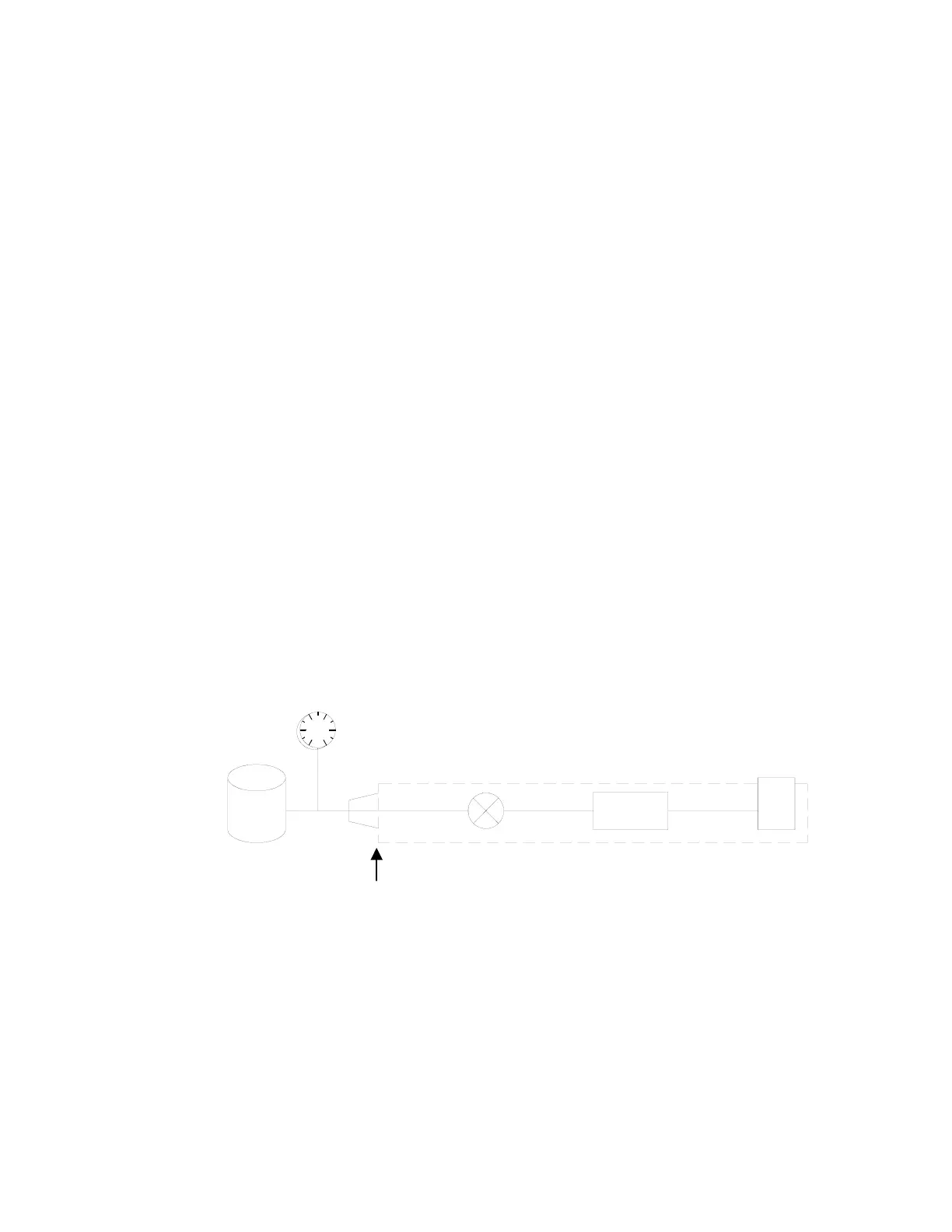
The next figure simulates a vacuum pump and a vacuum gage. The sensor
is set to a threshold value of –8 in Hg (27091 Pa). The tolerance is +/-1in
Hg (3386 Pa). If there is no leak from pump to chuck and the entire
vacuum pathway is plugged, any part of the pathway exhibits a pressure
value equal to the pump pressure. However, no system is completely leak-
tight and pressure values depend on the pump capacity, cross-sectional
flow areas, and the total volume to be evacuated.
Gage
With the recommended pressure of –20 in to –25 in Hg (67728 to 84660
Pa) at the fitting, it takes about 30 ms for the sensor to trigger with a wafer
on the chuck.
• If the pressure is less than –20 in Hg (67728 Pa), the lag time
increases, which has a direct impact on throughput.
• If the pressure is more than -25 in Hg {84660 Pa}, the pressure may be
enough to trigger the sensor when there is no wafer on the chuck,
known as a false positive.
Valve
Sensor
Chuc
Fitting
Pump



 To Next Page