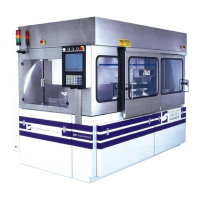
7AF Version 2.00 Features
3/9/95 Ken Hill
Purpose
Software version 2.00 for the model 7AF contains many new features. This document will briefly describe them.
Reference Wafer Diameter
Refererence wafer diameter for the Reference Chuck cycle in the Home screen was fixed at 6 inch (150mm) wafers. Now the
wafer diameter is determined by the DEFAULTO recipe. To change the wafer diameter required for the Reference Chuck cycle,
change the "Wafer Diameter" field of the DEFAULTO recipe.
Operator Instructions
At various points during operation, an information window will come up in the middle of the screen. Up to three lines will
appear to tell the operator what to do next. Pressing any item on the screen will clear the message. Most appear at the end of an
operational cycle or when a specific action is required by the operator. For example, when a dressing disk is needed, a message
requests that the dressing disk be placed on the work chuck and be acknowledged with the "Start" button.
Force Grinding Fault
If the grinder detects that the software force limit has been reached, it will temporarily stop feeding and post a fault message
that says the force limit has been reached. The fault will be cleared when the force is reduced or when the screen is exited.
Grinding will continue and the cycle probably should not be aborted. Turn the send cassettes to face the operator to prevent any
more wafers from entering the machine. Let the remaining wafers feed through the grinder. Immediately notify a process
engineer or technician. This indicates that there could be a process problem or the grind wheels may be loaded or worn.
If the fault comes up only occasionally and grind quality does not appear to be compromised, production may continue until the
problem can be evaluated. Tend to this matter soon, because grind quality will begin to be compromised and ignoring this fault
for a period of time can start causing damage to the wafers.
Wafer Thickness Fault
The "Thickness Fault" is displayed if a wafer is measured as out of tolerance before the grind begins. The coarse grind check
requires that the wafer be greater than 100 microns and less than the maximum wafer thickness in the selected recipe plus 50
microns. The fine grind checks for greater than 100 microns, too. If fine grinding only (not dual grind) a check is also made for
less than the maximum wafer thickness in the selected recipe plus 10 microns. If dual grind has been selected, the wafer is
checked for less than the final coarse grind thickness plus 10 microns.
Cross Slotted Wafer Fault
A fault will be generated if the robot detects a cross slotted wafer when scanning a cassette. If this happens, the cassette is
deactivated and the count is reported as empty for send cassettes or full for receive cassettes. This will prevent the cassette from
being used. The fault will be cleared when the cassette is turned to face the operator, presumably to correct the fault. This fault
can be caused by a wafer being cross slotted or the cassette not being seated properly.
Feed Deceleration
Required deceleration is checked while feeding the grind wheels during wafer grinding. The purpose is to prevent overshooting
from trying to decelerate the feeding wheel too quickly. If the distance to the final goal and the current feed rate exceeds a
maximum deceleration, the feed rate is reduced to meet the required deceleration. Therefore, the recipe steps can be treated as a
maximum feed rate, which may be reduced during the grind to get an acceptable deceleration rate. This deceleration in
microns/sec
2
can be set in the machine variables. The coarse deceleration is set in variable number 60 (1.0 recommended) and
the fine deceleration in variable number 61 (0.2 recommended).
The recipes are also checked for deceleration before quitting the Edit Recipes screen. If an excessive deceleration is detected, the
resulting deceleration is calculated and displayed as well as showing the recommended deceleration. A choice can be made to
accept the entry with "OK," or "CANCEL" and return to editing. If "OK" is chosen, a chance to avoid saving the edit altogether
will be offered if changes were made. To correct these rates, either use a lower feed rate or move the transition point further
from the goal. The decelerations allowed in the recipe are higher than those recommended above because the peak deceleration
is checked at the transition point to a lower feed rate. Step 3 is never checked because deceleration is always infinite at the end.
Therefore, the step 3 feed will always be under the control of the deceleration software as discussed.
Single Chuck Grinding
This feature is discussed in a separate document.



 To Next Page