D950 Digital Mixing System
1-4 Introduction SW V3.3 Date printed: 03.09.03
And unused DSP resources can be used as an automatic back-up in the rare
event of a DSP card failure that would normally cause a digital system to
be non-functional. If a hardware or software error is detected within a spe-
cific DSP board, the D950’s master CPU immediately assigns its functions
to any redundant DSP boards available within the system. A faulty board
can even be hot-plugged and replaced without interrupting operation of the
console. In this way, additional DSP cards can provide redundant func-
tions.
Redundant power supplies ensure that a session continues uninterrupted,
regardless of the problem. In the rare case of a PC or control surface fail-
ure, audio will continue to flow, although now without control. When a
subsystem comes back on-line, it is automatically and seamlessly recon-
nected to the system and control is regained. The PC reboots in less that
120 seconds, while reboot of the control surface is approximately 40 sec-
onds; reboot of the DSP Core is just six seconds.
Derived from the industry-proven D940/941 music and broadcast consoles,
but with dramatically enhanced and extended SHARC-based DSP func-
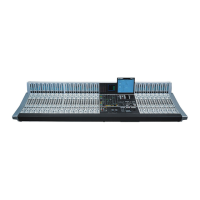
tions, the D950 Series comprises a user interface that connects via a sim-
ple, high-speed HDLC optical umbilical to a rack of I/O cards and proces-
sor engines. Up to four control surfaces can be connected to the same DSP
system core, for shared access to resources within a multi-room facility.
The D950 will run at 44.1 or 48 kHz sampling rates, with all of the popular
video-based pull-up/down offsets.
Swiss-Proven Design Developed in collaboration with the Swiss Federal Institute of Technology,
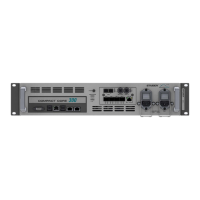
the D950’s DSP Core features powerful parallel processing; the maximum
DSP configuration of hot-swappable cards provides almost 15 GFlops of
DSP power. Each Core is capable of 40-bit floating point computation, and
is fully scaleable through load balancing – a topology that ensures that
virtually 100% of the processing power is available for any console con-
figuration. Each card will provide full DSP processing (EQ, dynamics,
delay, etc.) for up to 12 signal paths (if less processing is defined for spe-
cific module “types”, more channels can be accommodated per card).
Timing through the core is a consistent 240 microseconds regardless of the
amount of processing or the number of channels/busses.
Each DSP board shares access to a central back plane bus that enables
distributed processing. These PE (Processing Engine) boards can be sup-
plied in a variety of formats, with or without eight on-board AES/EBU-
format dual channel inputs (the first two pairs with integral sample-rate
conversion), and eight AES/EBU-format dual output ports. The D950’s
Core frame can accommodate up to 19 of these PE boards, in addition to
cards that handle a pair of optical MADI-format inputs and two outputs for
direct D-to-D connection, for example, to a Studer D827 24/48-track
DASH-format recorder. The D950 Core draws just 800 W of power from a
single-phase supply; an electrical load that makes it ideal for mobile appli-
cations and remotes. In the rare event of a power failure, a UPS (Un-
interruptible Power Supply) will operate the entire control system for up to
20 minutes.
Analog inputs/outputs are accommodated via outboard converters, includ-
ing Studer’s new range of D19m Series modular interfaces, for example,


 To Next Page