HIGH DATA RATE RECEIVER
HDR-4G+ USER’S MANUAL
Ref. DTU 100782
Is.Rev 3.5
Date: June 1, 2021
© Safran Data Systems – IMP000074 e14r1
This document is the property of Safran Data Systems.
It cannot be duplicated or distributed without expressed written consent.
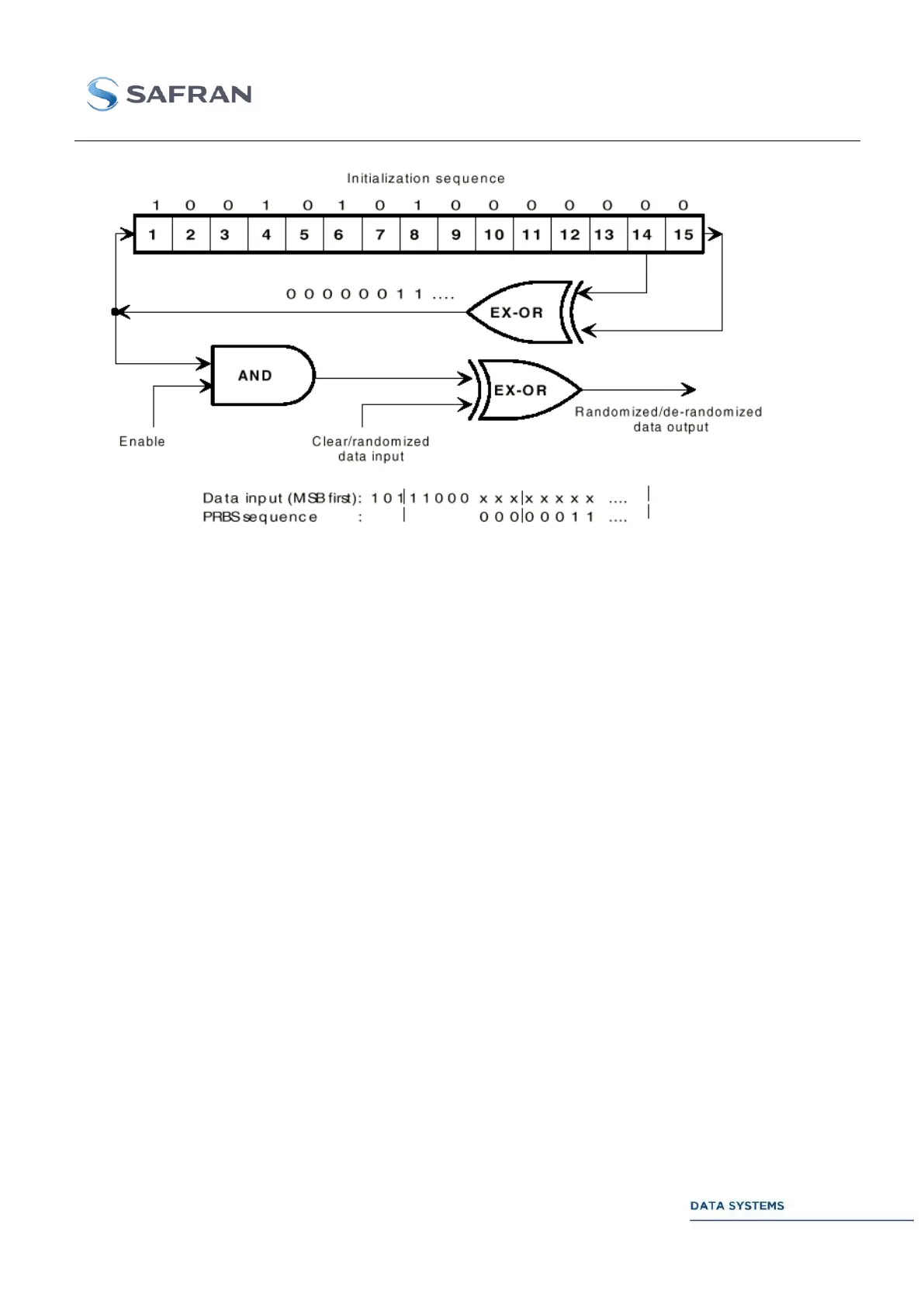
Figure 31: Randomization Principle
Reed-Solomon encoding 3.3.7.3.2
Then, the data shall be encoded by using a shortened Reed-Solomon encoder (238,254) type
The encoding process is the following:
first, one byte (00 hexa.) is added in front of the 238 data bytes
then a standard (239,255) R-S code (from DVB-S standard) is applied by computing 16
redundancy bytes.
finally the 00 extra-byte is removed
The code generation polynomial is: g(x) = (x+
0
)(x+
1
)(x+
2
)...(x+
15
) with =02 (hexa)
The primitive polynomial is: p(x) = 1+x
2
+x
3
+x
4
+x
8
Packets interleaving and synchronization byte insertion 3.3.7.3.3
After R-S encoding, the data shall be interleaved (depth 8 or 16) and formatted in transport frames.
The interleaving is performed by using a matrix of (8)16 rows and 254 columns. The 254-bytes packets
are written row by row, the first byte being put in the first cell. When filled, the matrix is read column by
column by packets of 254 bytes separated by synchronization markers. The process goes on with the
following group of 16(8)*254 data bytes creating then a complete frame of 16(8)*255 bytes.
The 16 (8) blocks of 255 bytes (254 data bytes plus one synchro. byte) form the transport frame. This
frame accounts for 4080 (2040) bytes or 32640 (16320) bits.


 To Next Page