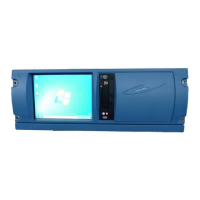
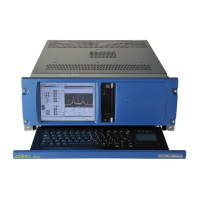
HIGH DATA RATE RECEIVER
HDR-4G+ USER’S MANUAL
Ref. DTU 100782
Is.Rev 3.5
Date: June 1, 2021
© Safran Data Systems – IMP000074 e14r1
This document is the property of Safran Data Systems.
It cannot be duplicated or distributed without expressed written consent.
After having started uihm.exe and connected it with the SPS software, the NTP server parameters are
available and can be set following, in the “uihm” window, the path Commands -> Hardware
Configuration -> NTP Configuration:
Time Management Procedures 4.5.3.3
Loss of Time Code or Time Code Missing 4.5.3.3.1
In case of wrong code selection or degraded or missing time code signal, the Time Code Reader
remains unlocked and generates its own time code in flywheel mode. When operating in flywheel
mode, time-tagging accuracy is set by the reference clock (internal or external) performances (see
Section 1.6.8.2 ). Should the time code be missing at boot up, the time will be initialized from the
Windows time.
Leap Second Management 4.5.3.3.2
As the earth’s rotation varies in relationship to atomically maintained time (UTC), it is often necessary
to officially add or delete a second from the UTC time scale. Insertion or removal of leap seconds can
occur as often as twice per year. Pending leap second changes are notified by the Paris-based Bureau
International de l’Heure (France).
If data time-tagging on the CORTEX require to be aligned on UTC, then the leap second changes can
be made either on the external Time Code Generator or on the CORTEX.
Leap second change on the external Time Code Generator:
If the change is made on the Time Code Generator, the Time Code Reader in the CORTEX will
lose lock for a short period of time (typically: 10 seconds) at the very moment the time
information, which modulates the time code signal, is updated.
Ensure that parameters Current Offset, Next Offset 1 and Next Offset 2 are set to 0 to avoid
taking twice into account the leap second change.
Leap second change:
Should it be mandatory to keep the Time Code Reader permanently synchronized (or if the
external Time Code Generator does not feature leap second entry), the leap seconds entry
must be done on the CORTEX instead of the external Time Code Generator.
Example: let us assume that:
the current leap second value is 10. Non leap year.
a positive leap second change (new value = 11) has been notified for July 1
st
, 00 h, 00
mn, 00 s
the CORTEX is started before June 30
st
, with all time offsets set to 0.


 To Next Page