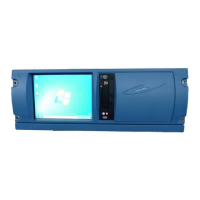
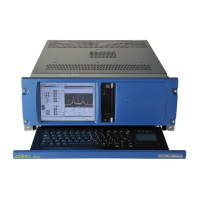
HIGH DATA RATE RECEIVER
HDR-4G+ USER’S MANUAL
Ref. DTU 100782
Is.Rev 3.5
Date: June 1, 2021
© Safran Data Systems – IMP000074 e14r1
This document is the property of Safran Data Systems.
It cannot be duplicated or distributed without expressed written consent.
Principle of the DEAF 3.3.2.3.2
The DEAF feature (DEAF stands for “Digital Equalization Automatic Filtering”) is a digital signal
processing technique based on the adaptive filters theory. It performs a blind equalization for satellite
communications of the incoming signal from the estimated statistics. It does not require additional
knowledge of the desired response: whereas conventional equalization techniques requires a training
period where a known data sequence is sent to the receiver in order to initialize the equalization device
then switches to a standard transmission mode, a blind equalizer switches automatically and smoothly
from the startup period to a standard transmission mode without training sequence.
The algorithm behind DEAF is a “Bussgang-like” algorithm implemented on a fractionally-spaced
equalizer for better performances:
Y is a vector of samples.
Z is the output vector of the equalizer.
C is the equalizer’s taps vector.
First step: initialization / C is initialized at C(0).
Second step: start-up / C is iteratively calculated /
where is the step-size and
a non-linear and zero-memory function of Z.
Third step: standard transmission mode / C() is used to filter Y.
The algorithm used by the DEAF device has a convergence time lower than 100 ms.
Use of the DEAF
3.3.2.3.3
The automatic digital equalization function is particularly efficient in the following operations:
- satellite filter equalization (transmission channel)
- compensation of perturbations due to multi-path signal
- compensation of I/Q shift (OQPSK modulation) with LMS algorithm
The main result of the DEAF operation is an important improvement of the measured Eb/No for high
data rates telemetry.
The following screen shot of the constellation display of the HDR shows the advantage of the DEAF for
filter equalization. The screen shot has been done during reception tests through an actual
transmission filter. The demodulator #1 is set without the DEAF and demodulator #2 is set with the
DEAF.


 To Next Page