HIGH DATA RATE RECEIVER
HDR-4G+ USER’S MANUAL
Ref. DTU 100782
Is.Rev 3.5
Date: June 1, 2021
© Safran Data Systems – IMP000074 e14r1
This document is the property of Safran Data Systems.
It cannot be duplicated or distributed without expressed written consent.
Error Due to Floating Representation 3.3.10.9.2
The floating representation may generate an error in Ts Ts2
-23
(for example, 0.1 + 1.4910
-9
s in the
case of 0.1 s programming), which could have generated an error on Doppler estimation of
.
But this floating representation is converted into double, owing to rounding processing, so that this error
is not added to the previous one (provided that the programmed sampling period does not have more
than 5 digits in its fractional part).
Es/N0 estimators in DVB-S2 and SCCC environment 3.3.11
Warning 3.3.11.1
The HDR unit has been designed for optimal demodulation and decoding of IF signals. As such, it also
provides some estimates of typical useful parameters such as Es/N0, IF Level and so on. However
these estimates are not intended to compete with dedicated constellation analysers in terms of
accuracy and precision.
Standard Es/N0 estimation 3.3.11.2
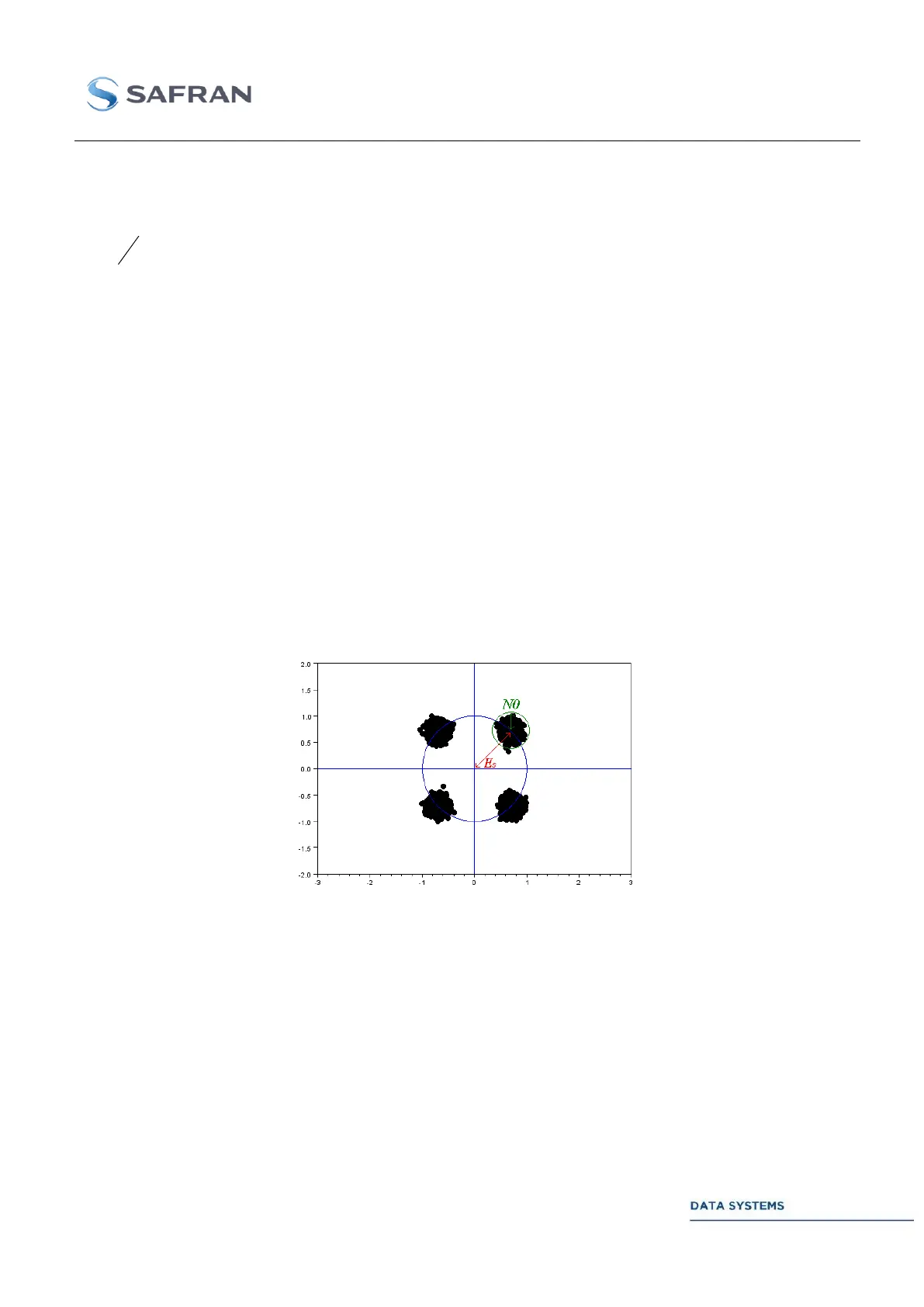
Let’s consider a QPSK modulation.
The standard method for Es/N0 estimation is to compute on the constellation the following values:
Mean Radius of the constellation. The square of this value leads to Es
Variance of the I/Q vector. This leads to N0.
Figure 34: Typical Es/N0 estimation over the constellation
This simple method can be applied in a similar way to multilevel modulations such as 16APSK and
32APSK.
This method is simple, but is biased at low SNRs (or Es/N0), when I/Q points easily cross the decision
regions, especially in high density modulation where those regions are very small. Below is a typical
example of this effect in different modulation schemes.


 To Next Page