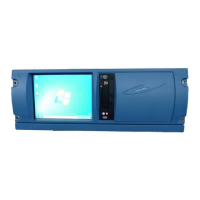
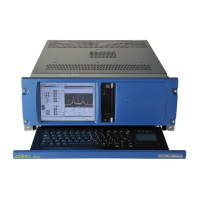
HIGH DATA RATE RECEIVER
HDR-4G+ USER’S MANUAL
Ref. DTU 100782
Is.Rev 3.5
Date: June 1, 2021
© Safran Data Systems – IMP000074 e14r1
This document is the property of Safran Data Systems.
It cannot be duplicated or distributed without expressed written consent.
CRC Frame Checking 3.4.5
Reconstructed frames will be verified only if parameter Frame Checking is set to CRC.
The CRC is user-programmable via two parameters: CRC Polynomial (CRC16, CCITT, etc…) and
CRC Preset Value (usually all bits set to 0 or to 1).
The CRC value is supposed to be the last two bytes of each frame. The CRC Preset Value is added to
the computed checksum.
(255,223) Reed-Solomon Decoding 3.4.6
Reed-Solomon coding technique is well suited for burst error correction. It can be used in conjunction
with convolutional encoding to allow data reconstruction with the lowest error probability. Reed-
Solomon decoding and error-correction by the CORTEX HDR complies to the CCSDS recommendation
101.0-B-3 (Blue Book - May 1992). The following coding characteristics should be used:
J = 8 bits per R-S symbol
Conventional and dual basis supported
E = 16 R-S symbol error correction capability within a R-S codeword (coded to decoded
information ratio = 255/223),
Interleaving depth: auto-adjusted from 1 to 8 (frame-length dependent),
Virtual filling for shorten RS code
Other characteristics: see CCSDS recommendation 101.0-B-3.
The Virtual fill length and Interleaving depth are automatically deduced by the HDR from the CADU
length set by the operator with the following formula:
For I = 1: 240 + 4 ≤ CL = (255-V) + 4 ≤ 255 + 4
For 1 < I ≤ 8: 240 x I + 4 < CL = (255-V) x I + 4 ≤ 255 x I + 4
V max = 15
CL max = 2044
CL min = 244
I: Interleaving depth
CL: CADU length (in bytes)
V: Virtual fill length (in bytes)
Vmax: Virtual fill length max (in bytes)
The R-S decoder status includes two counters (good frames and bad frames), the number of corrected
errors (per frame) and the BER.


 To Next Page