Power unit (check and adjustment)
7-1
Power unit (check and
adjustment)
Checking the compression pressure
1. Start the engine, warm it up for 5–10 min-
utes, and then stop it.
2. Remove:
•Clip
(from the engine shut-off switch)
• Fuel rail covers
See “Fuel hose assembly” (6-12).
• Ignition coils
• Spark plugs
See “Ignition coil and spark plug” (7-40).
Before removing the spark plugs, remove
any dirt or dust in the spark plug wells that
could fall into the cylinders.
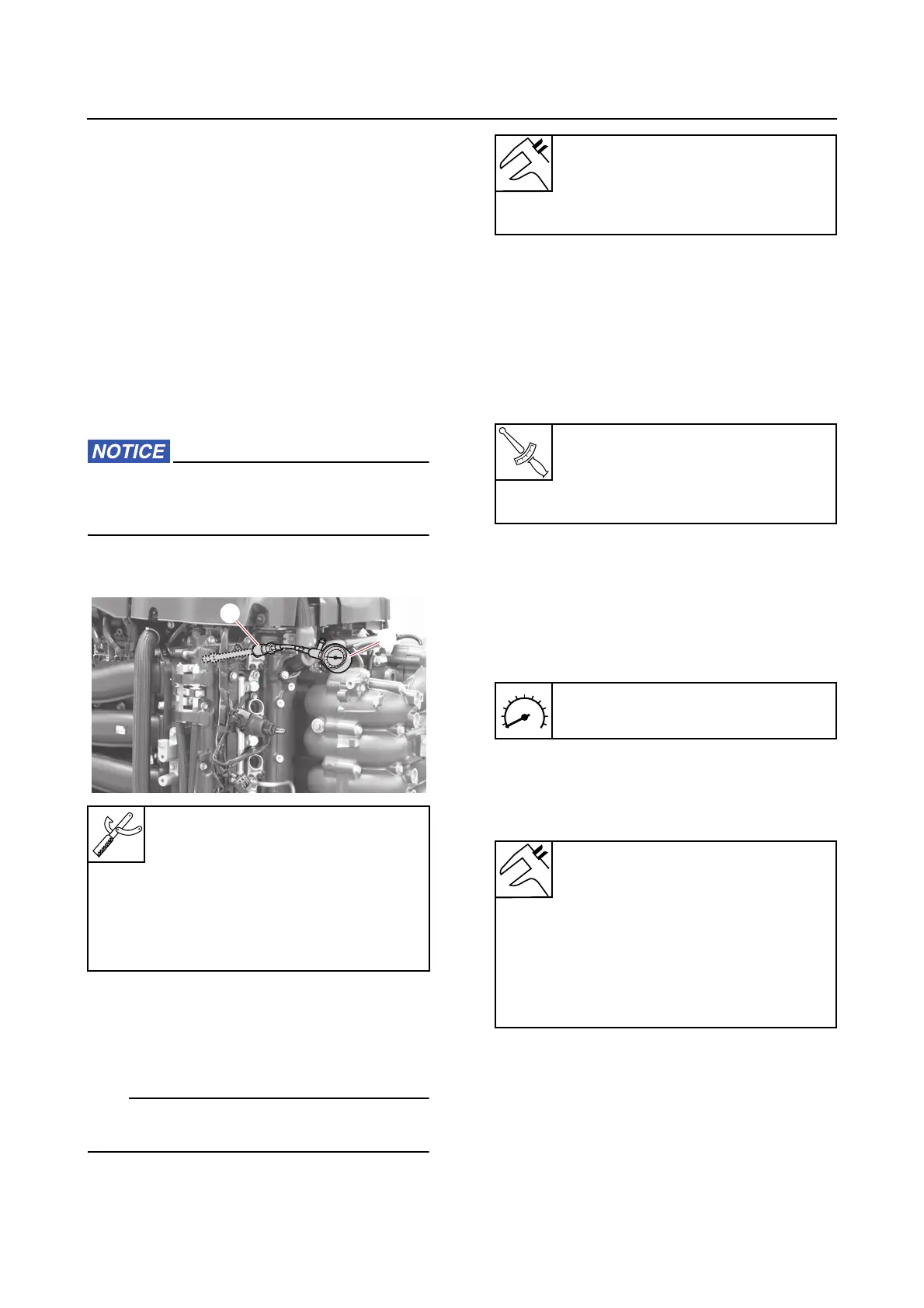
3. Install:
• Special service tools
4. Measure:
• Compression pressure
Below specification → Check the engine
internal parts.
Crank the engine until the reading on the com-
pression gauge stabilizes.
5. Remove:
• Special service tools
6. Install:
• Spark plugs
• Ignition coils
See “Ignition coil and spark plug” (7-40).
•Clip
(to the engine shut-off switch)
Checking the oil pressure
1. Connect the YDIS to display “Oil pres-
sure”.
2. Start the engine and warm it up until the
engine idle speed stabilizes at the speci-
fied engine idle speed range.
3. Measure:
• Oil pressure
Below specification → Check the engine
internal parts.
Checking the valve clearance
Measure the valve clearances when the en-
gine is cold.
Compression gauge “1”
90890-03160
Compression gauge extension
M10 “2”
90890-06582
Compression gauge “1”
YU-33223
Compression pressure
Minimum (reference data)
947.9 kPa (9.48 kgf/cm², 137.4
psi)
Spark plug
11 N·m (1.1 kgf·m, 8.1 lb·ft)
Ignition coil bolt
10 N·m (1.0 kgf·m, 7.4 lb·ft)
Idle speed (in neutral)
650–750 r/min
Engine oil pressure at idle speed
(reference data)
492.0 kPa (4.92 kgf/cm², 71.3
psi)
Engine oil pressure at 3000 r/min
(reference data)
676.0 kPa (6.76 kgf/cm², 98.0
psi)





 To Next Page