A
B
C
D
E
F
G
H
L
M
N
P
section
D 4
351098/1098S - M.Y. 2007 - edition 00
Use and maintenance
Checking brake pad wear and changing brake pads
Warning
Brake fluid will damage painted surfaces if spilled on them. It can also be very harmful if it comes into contact with the skin or
with the eyes; in the event of accidental contact, wash the affected area with abundant running water.
Important
When the motorcycle is consigned to the customer after changing the brake pads, inform the customer that the brake must be
used gently for the first 100 km to allow the pads to bed in completely.
Checking front brake pad wear.
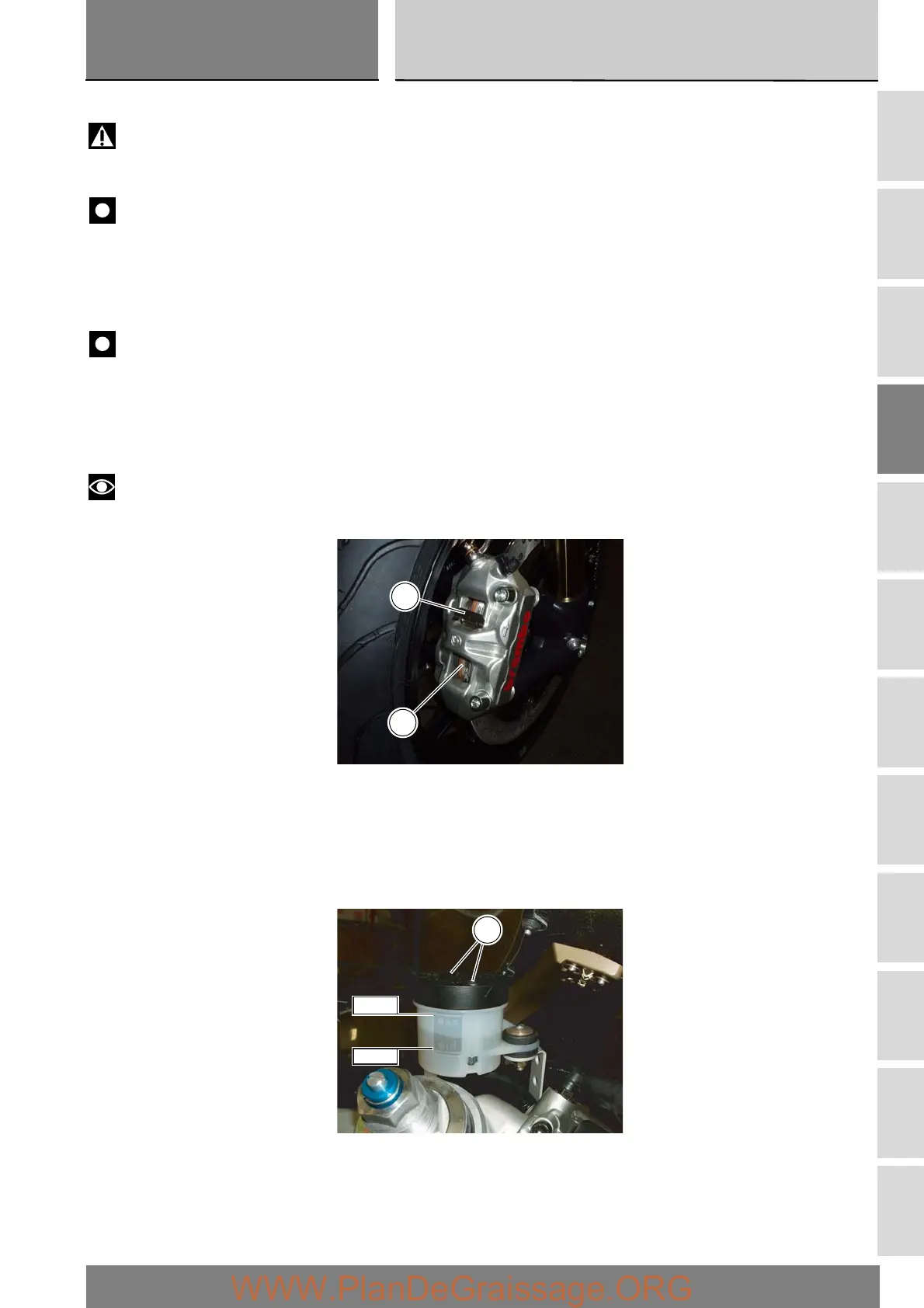
Look through the slot between the callipers to make sure the groove in the brake pad friction material (1) is still visible.
Important
If either of the pads is worn, both pads must be renewed as a set.
Change the brake pads as follows:
Remove the calipers (Sect. G 3).
Remove the safety clips (2) and force the caliper pistons back into their bores by forcing the old brake pads apart.
Remove the worn pads (1).
Notes
Change pads that have a shiny or “vitrified” appearance.
Insert the new pads with the relative safety clips (2).
Operate the brake lever repeatedly so that the pads are firmly bedded in against the disc by the force of the brake fluid.
Check that the brake fluid level in the master cylinder reservoir is above the MIN mark.
If necessary, top up as follows.
Turn the handlebar so that the reservoir is level.
Unscrew the two crosshead screws (3) and remove the reservoir cover.
Remove the inner membrane from the reservoir and top up with the recommended fluid to the maximum level mark.
Refit all previously removed components.
1
2
MAX
MIN
3




 To Next Page