FUNCTIONAL DESCRIPTIONS
10-12 Sysmex SF-3000 Operator's Manual -- Revised October 1995
7. RBC/PLT PARTICLE SIZE DISTRIBUTION ANALYSIS
7.1 RBC Particle Size Distribution
The RBC (red blood cell) count is found by measuring the number of particles whose
size is between a lower discriminator (LD) and an upper discriminator (UD), both of
which are automatically adjusted in the ranges of 25-75 fL (femtoliters) and 200-250 fL,
respectively. The particle size distribution is used to check the discriminator levels for
abnormal relative height, the existence of two or more peaks, and the distribution width.
The SF-3000 employs the following two methods to show the red blood cell distribution
width (RDW).
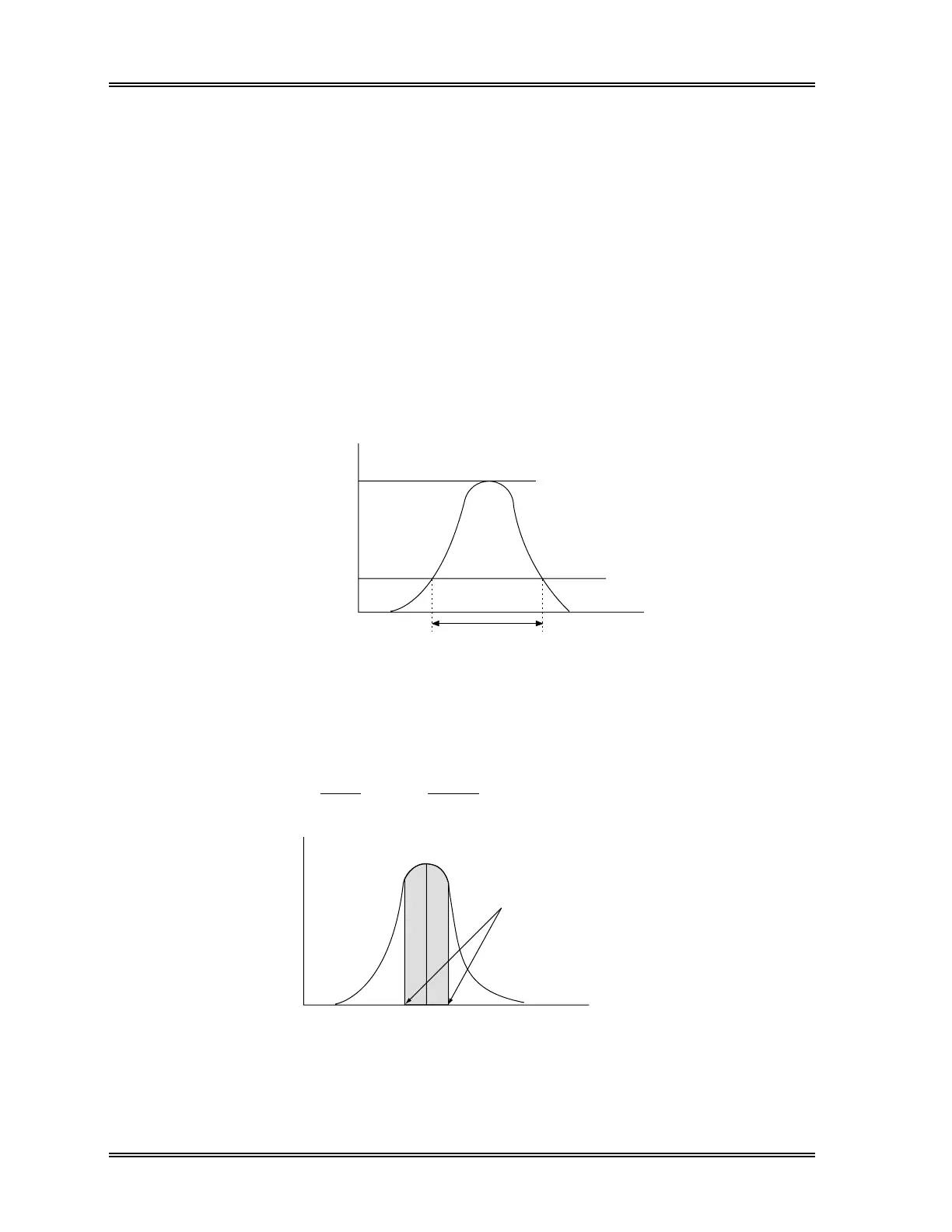
1 . RDW-SD
RDW-SD (RBC Arithmetic Distribution Width) is the arithmetic distribution width
measured at the 20% level when the peak is equivalent to 100%. The RDW-SD is
measured in fL (1 femtoliters = 10
-15
liter).
100%
20%
RDW
Figure 10-12: RDW-SD
2 . RDW-CV
RDW-CV (RDW-Coefficient of Variation) uses the formula below to calculate L1 and
L2, the points at which 68.26% of the area intersects the X-axis.
RDW-CV(%) =
SD
MCV
x 100 =
L2-L1
L2+L1
x 100
L2
(L1)
Points at which 68.26% of the
area intersects the X axis.
Figure 10-13: RDW-CV



 To Next Page