Free ebooks ==> www.ebook777.com
138
NIKON D5300
4
FLASH
Flash can be immensely useful, and the D5300 has great capabilities, but
flash photography can also lead to confusion and frustration. Flash is not
the answer to every low-light shot. Understanding its limitations helps us
understand when to seek other options, as well as when and how we can
use flash effectively.
›
Principles
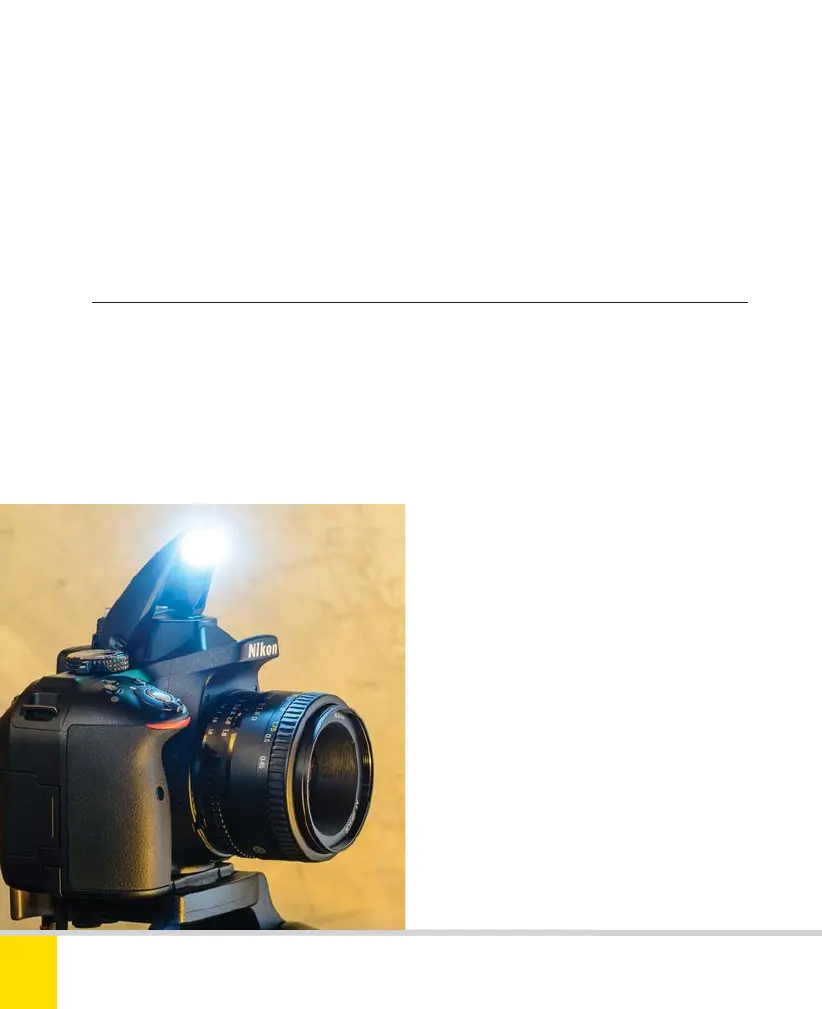
All flashguns are small; all flashguns are
weak. These two statements are key to
understanding flash photography. They are
especially true for built-in units like that on
the D5300 and most other DSLRs (the flash
units on compact cameras are typically
even smaller and weaker).
Because it’s small, the flash produces
very hard light. It’s similar to direct sunlight,
but even the strongest sunlight is slightly
softened by scattering and reflection; we
can use the same principles to soften the
flash, too.
The weakness of flash is even more
fundamental. All flashguns have a limited
range, and on-camera flash is more limited
than most accessory flashguns.
Built-in flash units raise a third issue,
too, namely their fixed position close to
the lens, which makes the light one-
dimensional—and the same for every shot,
which becomes boring. See Operating the
built-in flash on page 140.
Nikon D5300 Ch4 138-157 P2 RY.indd 138Nikon D5300 Ch4 138-157 P2 RY.indd 138 19/02/2014 16:4819/02/2014 16:48



 To Next Page
 Loading...