RTC6 boards
Doc. Rev. 1.0.21 en-US
9 Programming Peripheral Interfaces
299
Input Ports for External Encoder Signals
For receiving encoder signals, the
MARKING ON THE FLY socket connector provides
two encoder input ports (ENCODER X and
ENCODER Y), see Section ”Encoder Input Ports”,
page 82.
For linear movements of the parts to be processed, up
to two user-supplied incremental encoders (that
define, independently from each other, the
workpiece motion in the x direction and y direction)
can be connected to these input ports.
For rotational movements only one incremental
encoder is necessary. For Processing-on-the-fly
applications, it must be connected to input port
ENCODER X.
ENCODER X and ENCODER Y are each designed for a
pair of standardized differential input signals
(RS-422; HIGH level 2.0 V, LOW level 0.8 V).
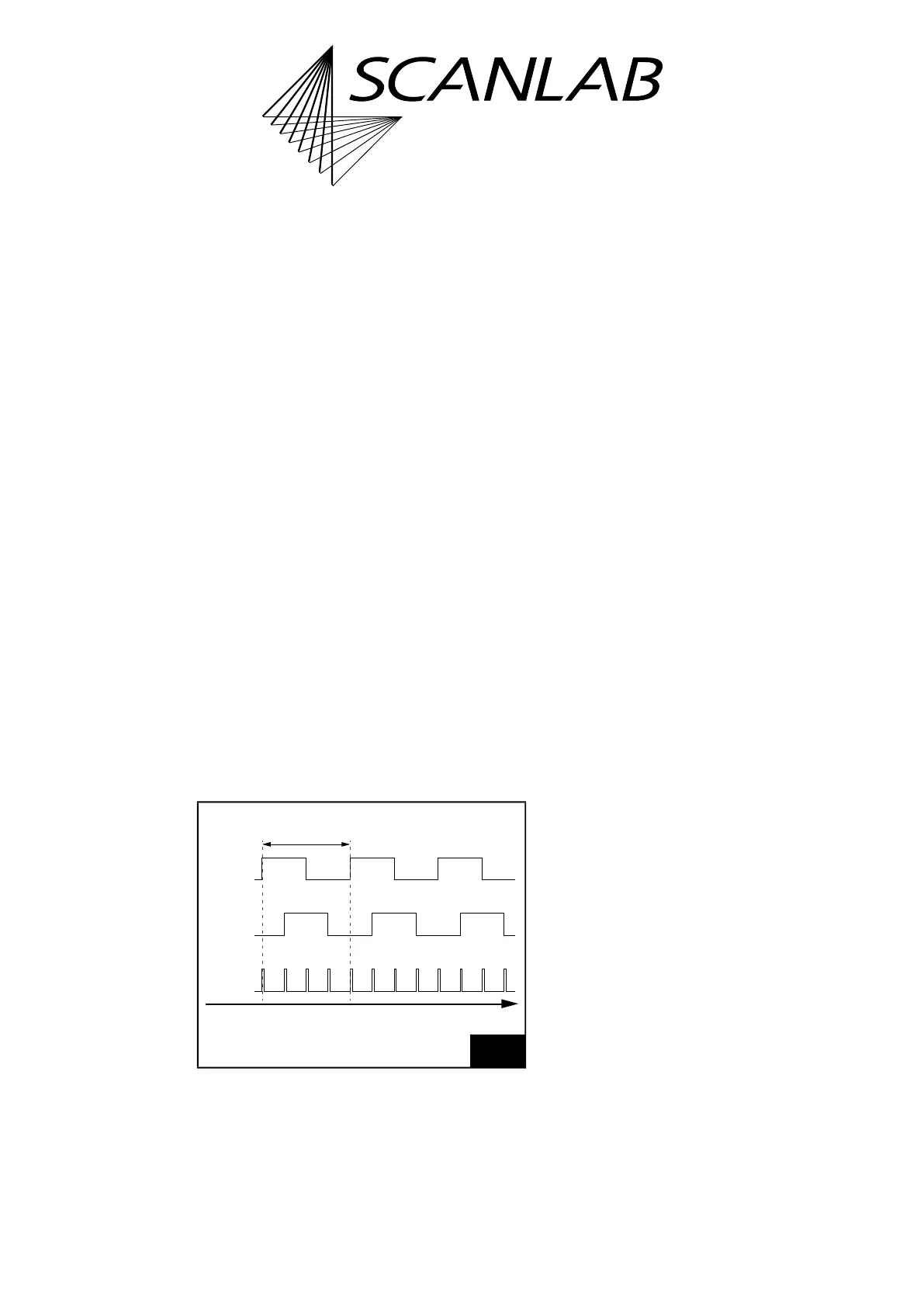
The timing diagram of a typical encoder signal pair
shows Figure 71. The second encoder signal is usually
phase-shifted by 90° relative to the first signal. The
corresponding RTC6-internal encoder counter
(1)
is
triggered at each edge of both signals, that is, one
encoder increment results in 4 counter pulses
(counts). The relative 90° phase-shift of the two
signals allows the RTC6 PCIe Board to detect the
movement direction of the workpiece as well.
Depending on the direction of movement, the
counter value is increased or decreased.
The signals at the encoder input port:
• ENCODER X trigger encoder counter “Encoder0”
• ENCODER Y trigger encoder counter “Encoder1”
The encoder signals should not exceed the maximum
allowed frequency of 4 MHz (16 encoder signal
edges / µs).
Encoder Simulation
The encoder simulation can be activated
(deactivated) by simulate_encoder. The
RTC6 PCIe Board provides a 1 MHz clock signal
(counter pulses), which replaces the signals of an
external incremental encoder.
(1) See Notice!, page 57.
71
Timing diagram of a typical encoder signal pair and of the
corresponding RTC5 counter pulses.
Encoder rotation angle
RTC
counter
pulses
Encoder
signal 2
Encoder
signal 1
Encoder increment
(360°)


 To Next Page