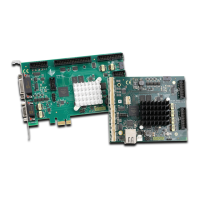
RTC6 boards
Doc. Rev. 1.0.21 en-US
2 Product Overview
58
2.11 Notes for RTC5 Users
RTC6 PCIe Board can control:
• Scan systems with SL2-100 interface
• Scan systems with XY2-100 interface
(in conjunction with the XY2-100 Converter
(Accessory))
The following is an overview of key differences
between RTC6 PCIe Boards and RTC5 boards.
Also described are possible approaches for migrating
RTC5 program code for use with RTC6 PCIe Boards.
Notes
• Users of excelliSCAN scan heads must
additionally read the “excelliSCAN Scan Heads –
Functional Principle of SCANahead Servo Control
and Operation by RTC6 Boards” Manual.
2.11.1 RTC6 PCIe Boards vs.
RTC5 Boards
Compared to the RTC5 board family, the
RTC6 PCIe Board uses newer and more powerful
hardware components. This applies in particular to
the DSP, the FPGA and the main memory.
Existing user programs only require a few changes,
see Chapter 2.12.2 ”Adapting RTC5 Source Code for
the RTC6 PCIe Board”, page 60.
Functionality changes
• The RTC6 PCIe Board executes short vectors
(1)
faster than RTC5 boards, see set_dsp_mode.
• The RTC6 List Memory features 8,388,608 (= 2
23
)
list positions. List 1 and List 2 are each initialized
with 4,194,304 (= 2
22
) list positions.
• The Pixel Output Mode is significantly enhanced,
see set_pixel_line.
– RTC6 PCIe Boards without Option “UFPM“ can
achieve pixel output frequencies of up to
800 kHz out-of-the-box.
– RTC6 PCIe Boards, with Option “UFPM“, even
up to 3.2 MHz.
– With set_pixel_line it is now possible to
digitally output laser power control values. This
can be done either at the 8-bit or 16-bit output
(EXTENSION 2 socket connector or
EXTENSION 1 socket connector).
• Extended measurement-value recording with the
RTC6 PCIe Board: 4 (8) recording channels, each
storing 8,388,608 (4,194,304) data values, see
set_trigger4 (set_trigger8). Practically any
amount of data can be recorded (ring buffer).
(1) “dashed lines”


 To Next Page