RTC6 boards
Doc. Rev. 1.0.21 en-US
9 Programming Peripheral Interfaces
282
9 Programming Peripheral Interfaces
Scan systems are often used in equipment that needs
to synchronize processing by the laser and
scan system with other process steps (for example,
workpiece placement, robotic motion, process
monitoring etc.).
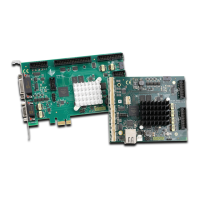
For this purpose, the RTC6 PCIe Board provides a
variety of peripheral interfaces, see Chapter 4.6
”Interfaces for the Laser and Peripheral Equipment”,
page 73.
With the commands for programming these
interfaces, you can supplementally and/or
synchronously control the following in addition to
lasers and scan systems:
• Signals transmitted for peripheral control
• Querying and evaluation of peripheral signals
• Control and synchronization of laser scan
processes and peripheral control by external
control signals
9.1 Signal Output
For peripheral control (for example, controlling a
workpiece transport system or a shutter), appropriate
signals can be outputted by the interfaces described
below.
The output values can be changed at any time by
control commands or – during processing of a list –
by list commands.
9.1.1 16-Bit Digital Output Port
The EXTENSION 1 socket connector provides a
buffered 16-bit digital TTL output
(DIGITAL OUT0…15). The level of its output signals
must be configured with a jumper, see Section
”16-Bit Digital Input Port and 16-Bit Digital
Output Port”, page 78.
16-bit digital values are assigned to the output port
by write_io_port_list, write_io_port,
write_io_port_mask_list, write_io_port_mask or
write_port_list. The output is in high-impedance
mode until an initial value is assigned to it. In
addition, set_port_default (
Port
= 3) can be used to
define the value to be outputted at the 16-bit digital
output port, as soon as processing of a list has ended
with stop_execution or by an external stop signal.
The default value also takes effect:
• With position-dependent and speed-dependent
laser control (see set_port_default)
• Upon terminating Pixel Mode
If “Automatic Laser Control“ is activated with
Ctrl=6
from set_auto_laser_control, then the value at the
16-bit digital output automatically gets adjusted, see
Chapter 7.4.9 ”“Automatic Laser Control“”,
page 197. This can be recorded by
set_trigger/set_trigger4/set_trigger8 (signal 24).
When the output value is outputted, a LATCH signal
is outputted at the EXTENSION 1 socket connector as
a trigger signal for synchronization of data
transmission.
By get_io_status, the current values of the digital
output port can be read out.


 To Next Page