RTC6 boards
Doc. Rev. 1.0.21 en-US
2 Product Overview
35
2.4 Intended Use
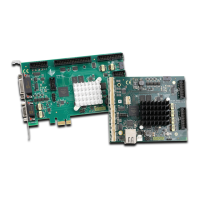
The SCANLAB RTC6 PCIe Board and its associated
RTC6 Software Package is intended for synchronous
real-time control of scan systems, lasers and
peripheral equipment by a Windows PC with a PCIe
bus interface.
RTC6 boards are available in different hardware
variants, Chapter 1 ”About this Manual”, page 24.
The delivered RTC6 DLL provides an extensive
command set for control. This allows a quick and
flexible software development for laser–scan
processes.
The RTC6 PCIe Board is equipped with a fast digital
signal processor (DSP). During execution of control
commands it also handles more complex signal
processing, such as simultaneous control of two
scan systems or coordinate transformations.
Moreover, you can store controlling commands
(= list commands) on the RTC6 PCIe Board and start
their execution at a later point in time. Command
execution by the RTC6 PCIe Board can then take place
independently of the host PC. This makes it possible
to meet the stringent demands of real-time control
for scan systems, lasers and peripheral equipment,
even if the PC must simultaneously respond to other
tasks such as machine control and network
communication.
The interface to the scan system, together with the
associated software commands, allows bidirectional
communication with the scan system, thereby
providing both control and monitoring capabilities
for the scan system.
With the RTC6 PCIe Board, commonly used laser
types can be controlled. To control lasers, the supplies
interfaces that output Laser Control Signals and are
software-configurable for each application’s
requirements.
Users can choose among different laser modes and
set the signal parameters (for example, the signal
level – active-HIGH or active-LOW) or the output
frequency to a suitable value.
For controlling peripheral equipment and
incorporating external control signals, the
RTC6 PCIe Board provides a range of interfaces (for
example, a 16-bit digital input port, a 16-bit digital
output port, two 12-bit analog output ports and an
RS-232 interface, see Chapter 4 ”RTC6 PCIe Board –
Layout and Interfaces”, page 64) and associated
software commands.
As many RTC6 PCIe Board as the PCIe bus permits can
be operated simultaneously in a single PC. The total
number of RTC6 PCIe Boards and RTC6 Ethernet
Boards must not exceed 255.
Moreover, the RTC6 DLL allows multi-threading as
well as multi-processing; therefore several
user programs can be used simultaneously.
No board can be simultaneously used by multiple
applications. Multiple threads of one user program
can use the same board, but can not send commands
to it at the same time. The RTC6 DLL serializes these
accesses automatically.
The RTC6 PCIe Board is available in various
configurations, see Chapter 2.6 ”Options”, page 38,
and Chapter 2.7 ”Jumper Settings and Type
Designations”, page 40.
The RTC6 PCIe Board interfaces are described on
Chapter 4 ”RTC6 PCIe Board – Layout and
Interfaces”, page 64, installation and start-up on
Chapter 5 ”Installation and Start-Up”, page 88, and
programming on Chapter 6 ”Developing RTC6-User
Programs”, page 93. Individual command
descriptions are listed beginning with Chapter 10
”RTC6 Commands”, page 302.
The technical specifications of the RTC6 PCIe Board
are summarized on Chapter 15 ”Technical
Specifications – RTC6 PCIe Board”, page 872.


 To Next Page