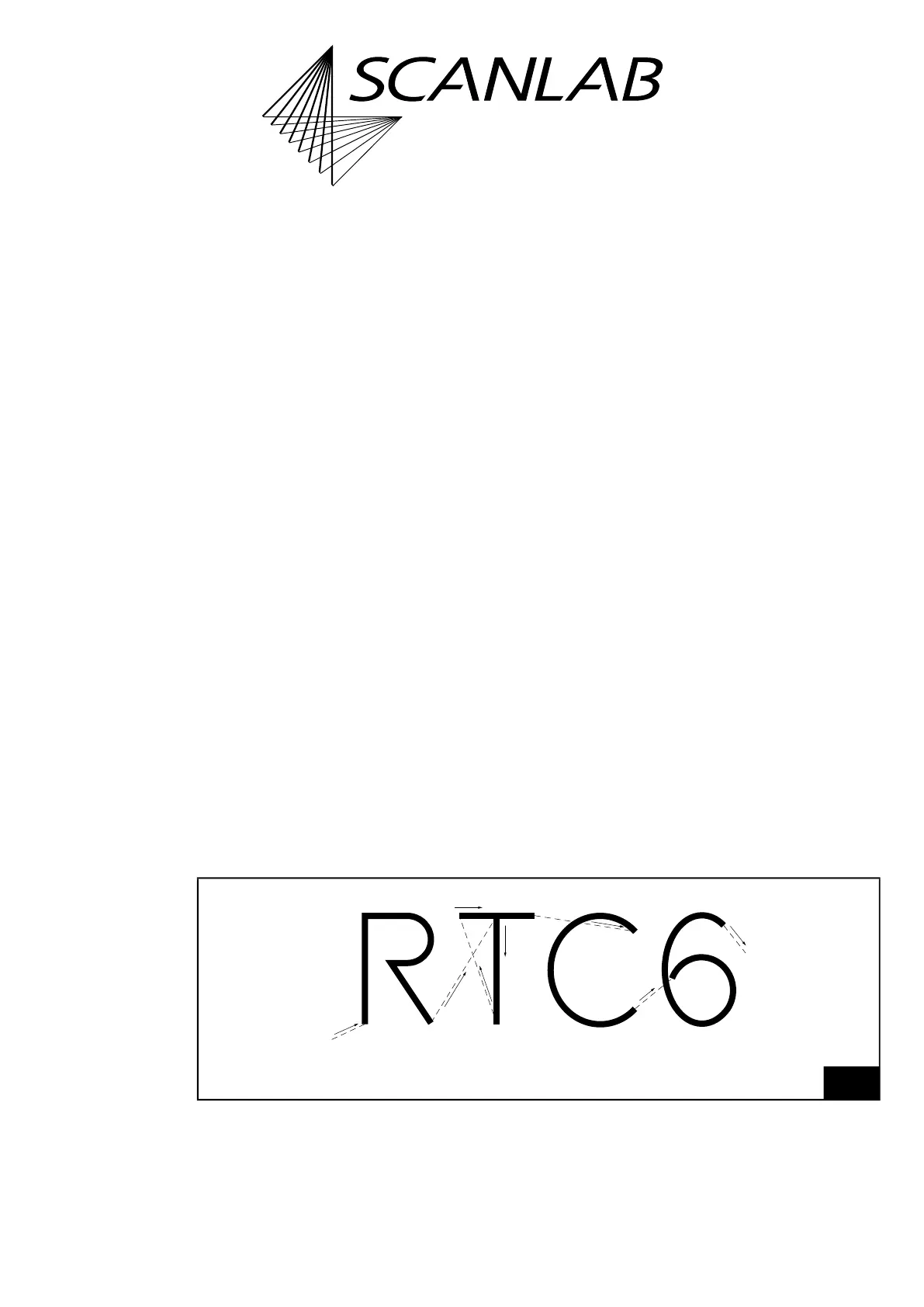
RTC6 boards
Doc. Rev. 1.0.21 en-US
6 Developing RTC6-User Programs
93
6 Developing RTC6-User Programs
6.1 RTC6 Software Concept
Basics
6.1.1 Controlling Scan Systems and
Lasers – An Introductory
Example
The SCANLAB RTC6 PCIe Board and its related
software are designed for controlling scan systems
and lasers.
To illustrate the principle of operation, Figure 31
shows a simple laser marking sample
(1)
. The lettering
is made up of straight line segments (vectors) and arc
segments. The RTC6 DLL provides a set of jump,
mark, arc and ellipse commands for laser processing
along such segments. Each of these commands
describes one vector or arc. Additional commands are
available for controlling the laser during the marking
process.
The RTC6 PCIe Board processes the commands it
receives and precisely transmits the required marking
signals to the scan head (using a predefined 10 µs
time raster) and to the laser. The scan head’s
galvanometer scanners accurately position their
deflection mirrors in synchronization with the
incoming control signals.
The current status of a scan head can also be queried
via the RTC6 PCIe Board using appropriate
commands.
For laser control, the RTC6 PCIe Board provides
various analog and digital signal output ports freely
available.
(1) In this manual, laser marking is mentioned only as an
example of the many possible laser materials
processing applications.
31
A laser marking sample.
Jump
Ellipse
Ellipse
Jump
Jump
Ellipse
Jump
Jump
Mark
Mark
Jump
Mark
Mark
Mark
Arc
Mark


 To Next Page