Page 6 2
nd
Edition – Rev 0
03-00
AIRPLANE GENERAL DESCRIPTION
Flight Controls
The flight control system controls the airplane in three axes. Ailerons, rudder and stabilator
are manually operated by a conventional control stick and rudder pedals, pulleys, cables,
bellcranks and rods.
Complete dual controls are provided for pilot and co-pilot.
Longitudinal control acts through a system of push-pull rods connected to the control stick
and moving the stabilator whose anti-servo tab works also as trim tab electrically operated.
Trim position is monitored by an indicator situated upper to left on the instrument panel.
A trim disconnect toggle switch is provided.
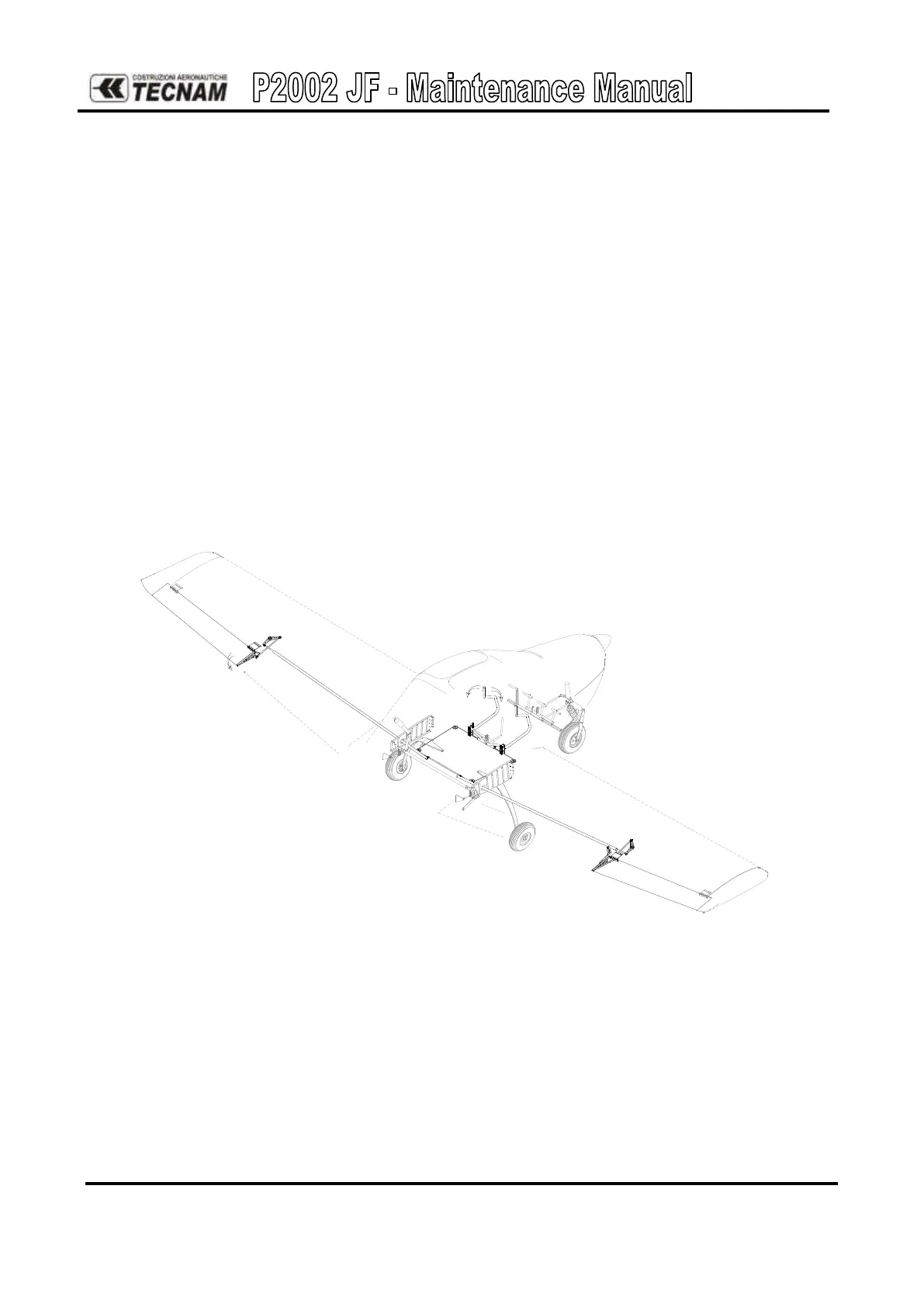
Aileron control is of mixed type with push-rods and cables; a cable control circuit is confined
within the cabin and it is connected to a pair of push-pull rod systems positioned in each main
wing which control ailerons differentially.
Stick controls the ailerons; its motion is transferred to the ailerons through a cable loop, up to
the interconnecting rod linking the two symmetrical push-pull rod systems which finally
transmit the motion to the ailerons.
Figure 6: Aileron system
Both flaps are extended via a single electric actuator controlled by a switch on the instrument
panel. Flaps act in continuous mode; the analog indicator displays three positions related to
0°, takeoff (T/O) and landing (FULL) positions.


 To Next Page