Page 5 2
nd
Edition – Rev 0
34-20
POSITION DETERMINING – DESCRIPTION AND OPERATION
Transponder
On P2002-JF two kinds of transponder devices can be installed: the Garmin GTX 328 and the
Garmin GTX 330.
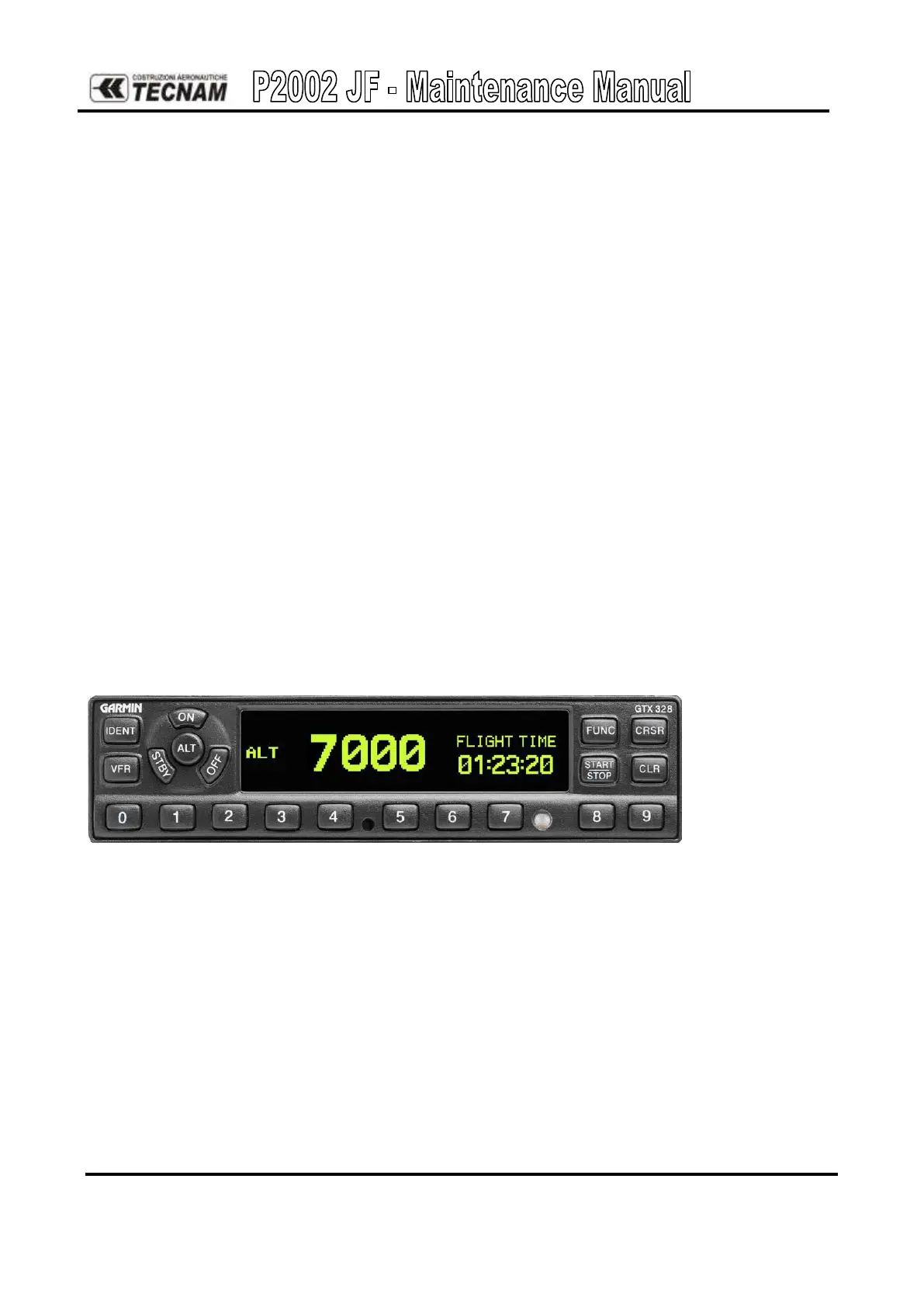
GTX 328 transponder
The Garmin GTX 328 is a Non-Diversity Mode S Transponder. The GTX 328 requires one antenna,
intended to be bottom mounted.
The GTX 328 Mode S Transponder is a radio transmitter and receiver that operates on radar
frequencies, receiving ground radar at 1030 MHz and transmitting a coded response of pulses to
ground-based radar on a frequency of 1090 MHz.
The GTX 328 is equipped with IDENT capability that activates the Special Position Identification
(SPI) pulse for 18 seconds.
The GTX 328 replies to ATCRBS Mode A, Mode C and Mode S All-Call interrogation. Mode A
replies consist of any one of 4,096 codes, which differ in the position and number of pulses
transmitted. Mode C replies include framing pulses and encoded altitude. Mode S interrogations are
selective. The Mode S transponders can respond to a single directed interrogation from the ground
station or another aircraft.
Ground stations interrogate Mode S Transponders individually using a 24-bit ICAO Mode S
address, which is unique to the particular aircraft. In addition, ground stations may interrogate a
GTX 328 for its Transponder data capability and the aircraft's Flight ID, which may be the
registration number or other call sign.
The GTX 328 is configured with all key controls. The layout of the front panel keys and displays
segregates the transponder’s primary functions from the secondary functions.
GTX 330 transponder
The Garmin GTX 330 is a Non-Diversity Mode S Transponder and requires one antenna, intended
to be bottom mounted.
The general features are the same with respect to the GTX 328 device; additionally this unit also
features an altitude monitor, TIS traffic advisories and flight timers.


 To Next Page