TEEJET 5000 OPERATORS MANUAL SEED DRILL, SIMBA
5.65
TRAMLINE CONTROL
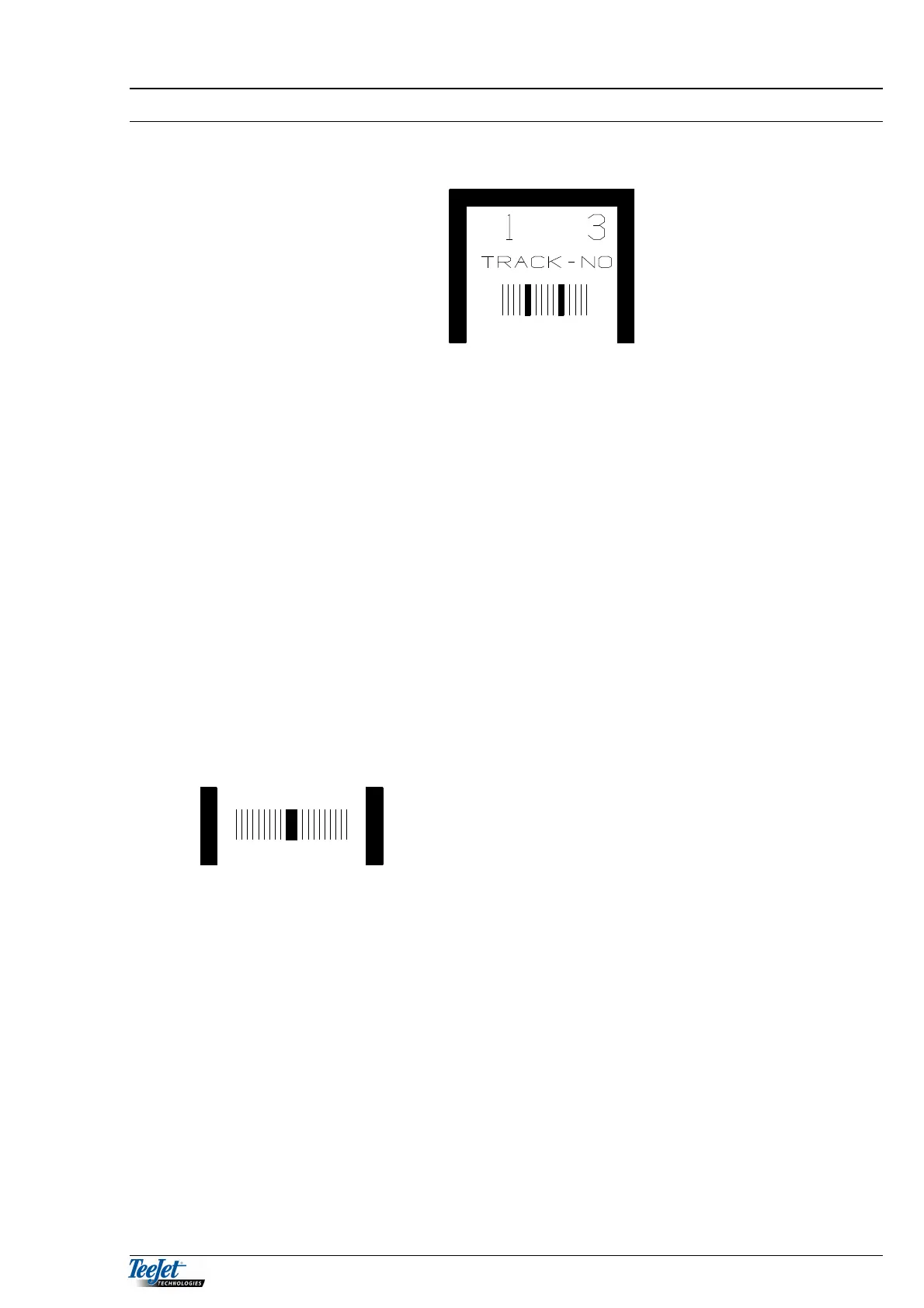
The primary function for seed drills is the track number. The following picture is
displayed:
Bout number Track number
The bout number is the present bout being driven in the field (counts 1 each time
the drill is lifted). The track number is what has been encoded (see “ENCODE”).
The TeeJet 5000 has 2 different methods of controlling the tramlines (A and B).
The method is selected under “ENCODE”:
METHOD A
This method is a new and logical method of making tramlines.
If the tramlines are to be made on uneven bouts (3,5,7, or 9) then the tramlines will
always be made in the middle bout. Two clutches are fitted to the middle of the
drill. See the drawing for METHOD A UNEVEN.
If the tramlines are to be made on even bouts (2,4,6, or 8), then the tramlines are
split between the 2 middle bouts. The field must be sown up and down as there is
only 1 clutch fitted on one side of the seed drill. See the drawing for METHOD A
EVEN.
The tramlines are displayed for this method thus:
METHOD B
This method is older and better known. Tramlines are made when the present bout
is the same as the track number. The operator must know how the field has been
started.
If tramlining is required in on uneven bouts (3,5,7, or 9) the system works well.
Tramlines are made, using 2 clutches fitted in the middle of the seed drill, when
the present bout number is the same as the encoded track number. See the
drawing METHOD B UNEVEN.
If the tramlines are to be made on even bouts (2,4,6, or 8), then the operator must
drive around the field with only one half of the seed drill open. This is necessary,
as the tramlines cannot be split over 2 bouts. The clutches are fitted in the middle
of the seed drill, and the tramlines are made in one bout. See the drawing
METHOD B EVEN.



 To Next Page