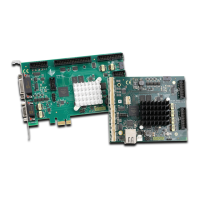
RTC6 boards
Doc. Rev. 1.0.21 en-US
7 Basic Functions for Scan Head Control and Laser Control
171
Notes
• As of RTC6 Software Package V1.12.0, you can
leave the focus length value l in RTC6 20-bit
range [–524,288…+524,287], if you use
load_z_table_20b / load_z_table_no_20b and
read_abc_from_file_20b /
write_abc_to_file_20b.
• ABC values from the
*_ReadMe.txt
file of
correction file are to be interpreted as
16-bit values.
Procedure
• Refer also to the “Calibrating a 3-Axis Laser Scan
System” Manual.
• See also Notes, page 171.
(1) Adjust the correct mechanical distance between
the scan system and the z = 0 working plane and
the correct distance between the
varioSCAN device and the scan system
(1)
.
(2) Load the 3D correction file by
load_correction_file.
(3) Assign the 3D correction table by
select_cor_table.
(4) Read out the assigned coefficients A, B and C by
get_head_para.
(5) varioSCAN FC and intelliWELD FC only: proceed
with step 10. Steps 6…9 do not need to be
performed.
(6) Move the laser spot to the reference point
(2)
by
goto_xyz.
(7) Set the z axis to the neutral (middle) position by
load_z_table_20b(0, 0, 0).
(8) Place a test object at the reference point.
(9) Adjust the laser focus, see page 170.
(10)Move the focus to an arbitrary point (x|y|z)
within the (required) 3D Image Field by
goto_xyz
(3)
.
(11)Query the focus length value l (in RTC6-20-bit
range [–524,288…+524,287]) set by the
RTC6 PCIe Board for this point
(4)
by
get_z_distance.
(12)Optimize the laser focus at this point:
vary the Z output value z
out
until the quality of the
laser focus meets your requirements
(5)
by
load_z_table_20b(A=z
out
, 0, 0).
A starting value can be calculated in accordance
with A + Bl +Cl
2
by using the previously read
focus length value l and the previously read or
used values A, B and C.
(13)Repeat steps 10…12 for as many locations
(x|y|z) as possible
(6)
and write down the values
(l|z
out
) for each new point. If possible, seek to
thereby cover the entire 3D Image Field required
by your application.
(14)Fit the function z
out
= A + Bl +Cl
2
to your value pairs (l|z
out
).
(15)Use the resulting coefficients A, B and C to adjust
the 3D correction table by load_z_table_20b(A,
B, C).
Values loaded by load_z_table_20b are overwritten
by a subsequent load_correction_file
(load_correction_file sets the three coefficients A, B
and C to the values of the loaded correction table).
After each load_correction_file or select_cor_table,
you should therefore also call
load_z_table_20b(A, B, C) again.
By load_z_table_no_20b, the three coefficients
A
,
B
,
C
can be assigned to correction table
No
. They are
switched with select_cor_table.
Alternatively, the ABC values can be written
permanently to the header of the correction file by
write_abc_to_file_20b, see also parameter 5…7 in
Section ”ct5 Correction File Header”, page 178.
(1) See the corresponding manual.
(2) The reference point is a point in the z = 0 working
plane for which a middle focus length value is required
for a sharp laser focus. The laser beam should be
focused to the reference point when the z axis is set to
the neutral position (Z output value z
out
= 0). The
coordinate values of the reference point (in mm) are
provided in the
*_ReadMe.txt
file that accompanies the
3D correction file or in the 3-axis scan system’s or the
varioSCAN user manual. If you are using an F-Theta
objective, the reference point is generally the origin
(0|0|0).
(3) If you are using a scan system with an F-Theta
objective, it is sufficient to select various points (0|0|z)
on the z coordinate axis. The maximum possible
3D Image Field is specified in the corresponding user
manual.
(4) The focus length value l c
an be positive or negative,
see notes on get_z_distance.
(5) The optimal z
out
output value can be positive or
negative.
(6) Note that larger z control values lead to shorter
working distances and that the focus thereby shifts
toward the scan system. The test object might have to
be tracked accordingly.


 To Next Page