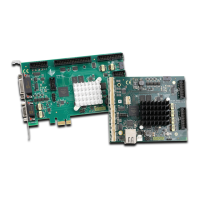
RTC6 boards
Doc. Rev. 1.0.21 en-US
16 Appendix A: The RTC6 Ethernet Board
876
16 Appendix A: The RTC6 Ethernet Board
16.1 Product Overview
16.1.1 RTC6 Ethernet Board vs.
RTC6 PCIe Board – Usage and
Comparison
RTC6 Ethernet Boards and RTC6 PCIe Boards share
the same core functionality:
• Real-time control of the laser and scan system.
• Transfer of direct commands (control commands)
from the computer to the board. These
commands are executed immediately.
• Transfer of list commands from the computer to
the RTC6 List Memory. These commands execute
only after the list is started.
• List execution occurs in real time.
• Calculation of the set position occurs every 10 µs.
• Image Field correction is applied to the
set positions.
• The interface to the scan system uses the
20-bit SL2-100 protocol.
• For software development, the total command
set for RTC6 Ethernet Boards and
RTC6 PCIe Boards is contained in
RTC6DLL.dll
/
RTC6DLLx64.dll
.
RTC6 Ethernet Boards differ in the following aspects:
• Ethernet interface
(1)
instead of PCIe bus
– Communication with the computer is by TCP/IP
and UDP.
– RTC6 Ethernet Boards work without
RTC6 board driver.
– The board does not need to be plugged into a
PC.
– Real-time clock, see Chapter 16.2.15
”Real-Time Clock”, page 897.
– With RTC6 Software Package V1.7.0,
RTC6 Ethernet Boards can also be used in
standalone operation without a PC, see
Chapter 16.7 ”Standalone Functionality”,
page 908.
(1) Supports Gigabit Ethernet according to 1000BASE-T.


 To Next Page