3 WLAN Mode
3.8 Power vs Time Measurement
3.8 Power vs Time Measurement
This measurement is designed for testing 802.11b signal. It measures power vs. time
in the time domain. From envelop of power vs. time trace, transient periods (power-
on ramp period or power-down ramp period) can be detected, then the transient
periods can be compared with limits specified in specification for pass/fail
judgment.
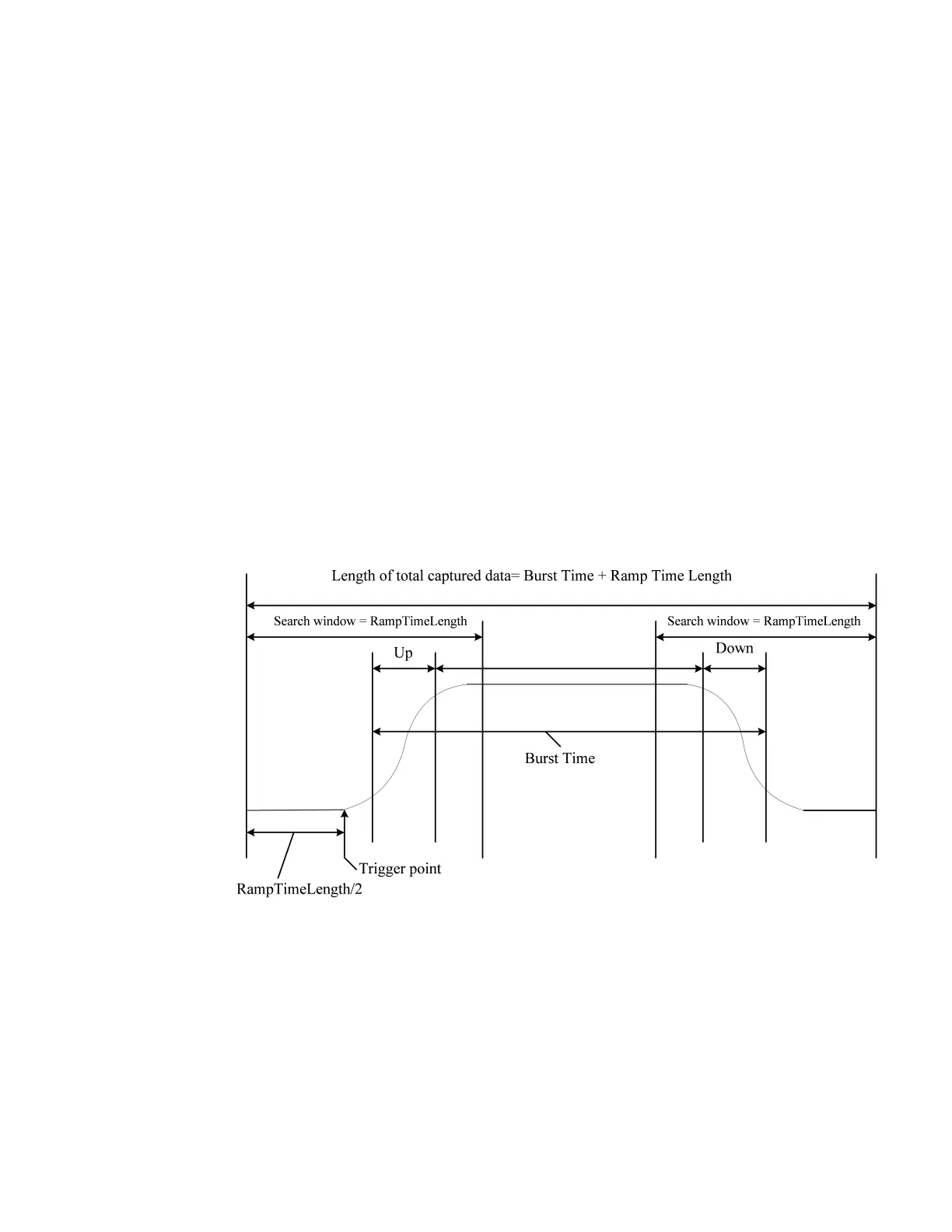
In this measurement, trigger must be provided by customer. Depending on trigger,
the signal which is a little bit longer than one burst is captured. It starts from –
(Ramp Time Length)/2, in which Ramp Time Length indicates the ramp searching
window and set by customer, ends to (Burst Time +Ramp Time Length), here, Burst
Time is search length in which one entire RF burst must be included. Please note,
the Burst Time should not be shorter than the actual burst length, otherwise power-
down ramp may be lost. The captured data in search window is then smoothed to
determine max power point. By using max power point, the ramp up and down can
be determined in term of 10% to 90% power range of max power point. Some
parameters mentioned above can be explained clearly from the figure below,
The Power vs Time measurement automatically handles all 802.11b signal formats,
including the short preamble and the PBCC formats (though it doesn't decode the
bits of the PBCC formats). The measurement also automatically handles all 802.11g
formats that are compatible with 802.11b, including the PBCC22 and PBCC33
modes (though it again doesn't decode the bits of these PBCC formats).
Power vs. Time Measurement Commands
The following commands are used to retrieve the measurement results:
WLAN Mode User's &Programmer's Reference 1310



 To Next Page