MPC5553/MPC5554 Microcontroller Reference Manual, Rev. 5
Freescale Semiconductor 18-11
for motor control. Refer to Section 17.2.1.2, “Output Disable Input—eMIOS Output Disable Input
Signals,” for more information.
18.3.2 Detailed Signal Description
18.3.2.1 Output and Input Channel Signals
The channel signal connections for eTPU engine A (in both the MPC5553 and the MPC5554) and eTPU
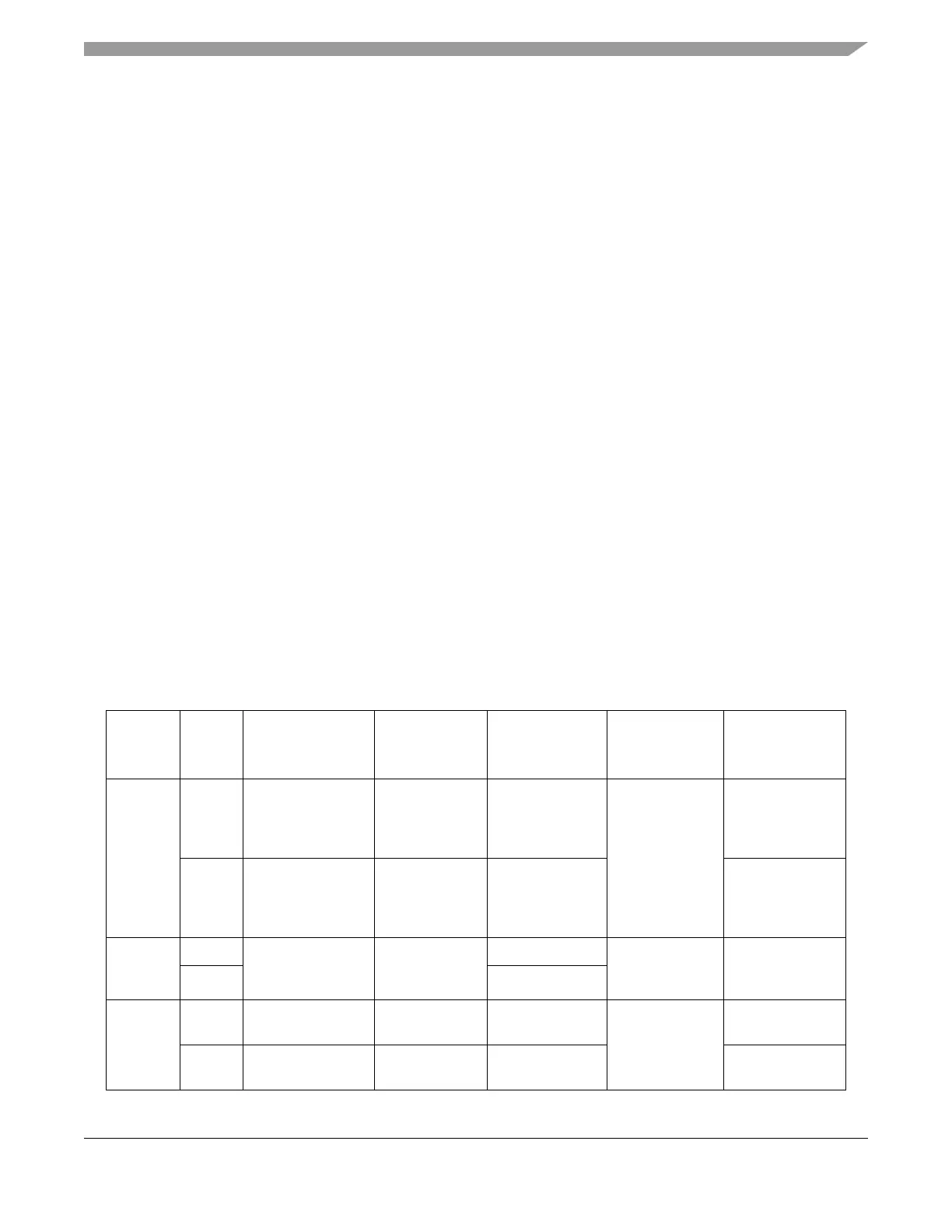
engine B (only in the MPC5554) are described in Table 18-1 and Table 18-2, respectively. Each eTPU
channel has an input and output associated with it. In Table 18-1 and Table 18-2 this is represented by the
Input/output column. The eTPU channels can be connected to external pins or wired internally to other
peripheral devices. In the MPC5553/MPC5554, some of the eTPU channels are connected to pins. The pin
connections are represented by the Pin Number column in Table 18-1 and Table 18-2. To the right of the
Pin Number column is the eTPU Channel Connections column that shows the channel number that
corresponds to each input or output pin. Many of these pins are multipurpose, that is they are multiplexed.
Table 18-1 and Table 18-2 shows the other non-eTPU signals listed in the Signals with Which eTPU Signal
is Shared column.
To reduce the number of pins required by the MPC5553/MPC5554’s eTPU while still maintaining the
eTPU’s functionality, the eTPU is also internally wired to the DSPI (20.1, “Introduction”). The DSPI
connections are shown in the column labeled DSPI Serial Channel Connections in Table 18-1 and
Table 18-2. The eTPU microcode may be programmed to set the output level of an eTPU channel in one
of two manners:
• By forcing the logic level to a specified value
• By specifying the logic level output action when a match or transition event occurs
Every eTPU channel input has a digital filter. This filter is designed to filter out noise pulses that have
width less than a specified value. This prevents small noise glitches from being recognized by the
transition detect logic. Any pulses wider than the specified filter width will be passed to the channel
transition detect logic.
Table 18-1. eTPU A Channel Connection Table (both MPC5553 and MPC5554)
eTPU
Channel
Number
I/O Pin Number
eTPU Channel
Connections
DSPI Serial
Channel
Connections
eTPU A
Signal
Signals with
Which eTPU
Signal is Shared:
0-9 I N3
M4–M1
1
L4–L1
1
K4
0
1–4
5–8
9
not connected
eTPU_A[0:9]
eTPU_A[12:21]
(output only)
GPIO[114:123]
O AF15, AE15, AC16,
AD15, AF16, AE16,
AD16, AF17, AC17,
AE17
0–9 DSPI_C[4:13] eMIOS[0:9]
GPIO[179:188]
10–11 I K3–K2
1
10–11 not connected
eTPU_A[10:11]
eTPU_A[22:23]
(output only)
GPIO[124:125]
O DSPI_C[14:15]
12–15 I K1
J4–J2
1
12
13–15
not connected
eTPU_A[12:15]
GPIO[126:129]
ON3
M4–M2
1
12
13–15
DSPI_C[0:3] eTPU_A[0:3]
GPIO[114:117]



 To Next Page