MPC5553/MPC5554 Microcontroller Reference Manual, Rev. 5
19-82 Freescale Semiconductor
RFIFO. Using POPNXTPTR and RFCTR, the absolute addresses for pop next data pointer and receive
next data pointer can be calculated using the following formulas:
Pop Next Data Pointer Address= RFIFOn_BASE_ADDRESS + POPNXTPTRn*4
Receive Next Data Pointer Address = RFIFOn_BASE_ADDRESS +
[(POPNXTPTRn + RFCTRn) mod RFIFO_DEPTH] * 4
where
• a mod b returns the remainder of the division of a by b.
• RFIFOn_BASE_ADDRESS is the smallest memory mapped address allocated to an RFIFOn
entry.
• RFIFO_DEPTH is the number of entries contained in a RFIFO - four in this implementation.
When a new message arrives and RFIFOn is not full, the eQADC copies its contents into the entry pointed
by receive next data pointer. The RFIFO counter EQADC_FISRn[RFCTRn] (see Section 19.3.2.8) is
incremented by 1, and the receive next data pointer n is also incremented by 1 (or wrapped around) to point
to the next empty entry in RFIFOn. However, if the RFIFOn is full, the eQADC sets the
EQADC_FISRn[RFOF] (see Section 19.3.2.8). The RFIFOn will not overwrite the older data in the
RFIFO, the new data will be ignored, and the receive next data pointer n is not incremented or wrapped
around. RFIFOn is full when the receive next data pointer n equals the pop next data pointer n and
RFCTRn is not 0. RFIFOn is empty when the receive next data pointer n equals the pop next data pointer
n and RFCTRn is 0.
When the eQADC RFIFO pop register n is read and the RFIFOn is not empty, the RFIFO counter RFCTRn
is decremented by 1, and the pop next data pointer is incremented by 1 (or wrapped around) to point to the
next RFIFO entry.
When the eQADC RFIFO pop register n is read and RFIFOn is empty, eQADC will not decrement the
counter value and the pop next data pointer n will not be updated. The read value will be undefined.
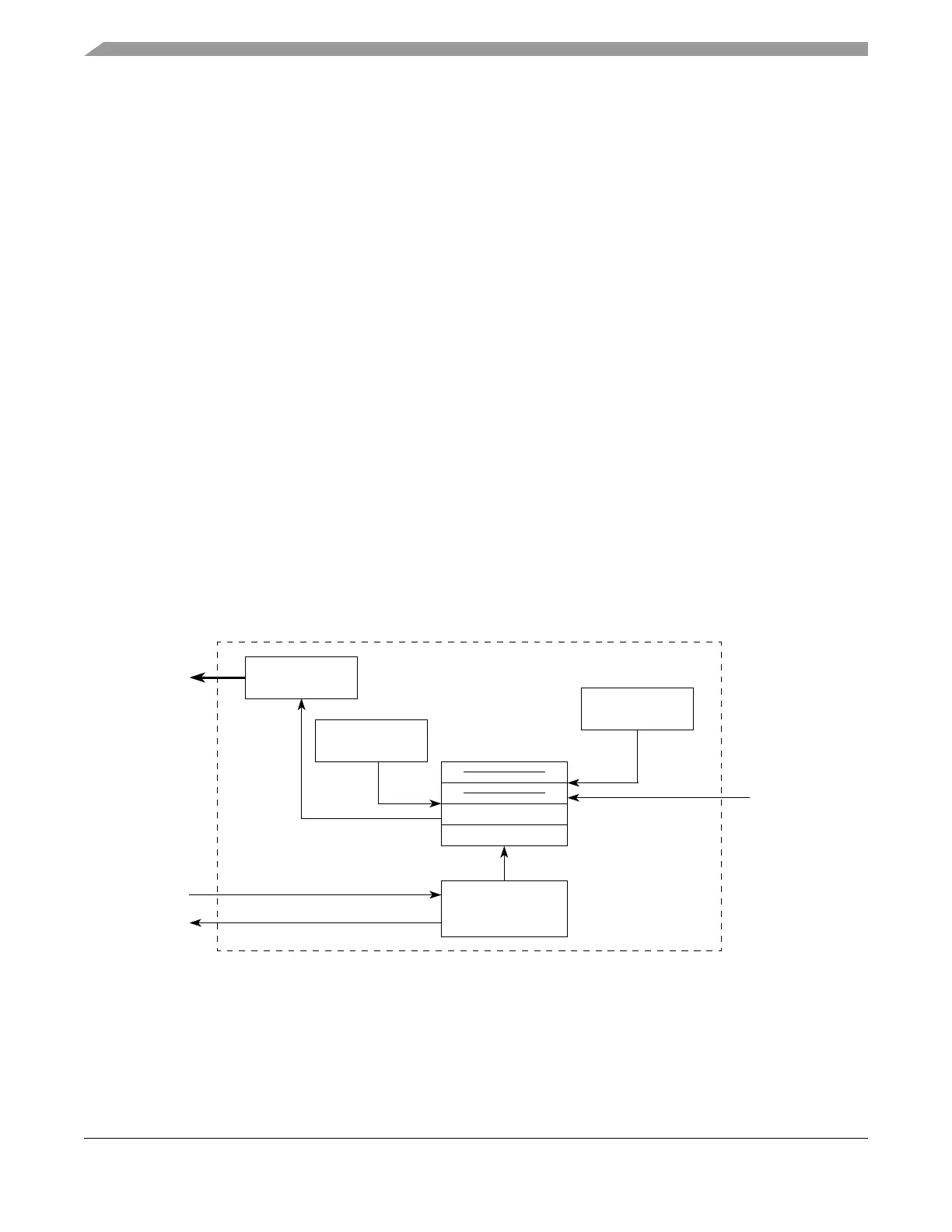
Figure 19-46. RFIFO Diagram
The detailed behavior of the pop next data pointer and receive next data pointer is described in the example
shown in Figure 19-47 where an RFIFO with 16 entries is shown for clarity of explanation, the actual
Pop Next
Data Entry 1
Data Entry 2
Control Signals
RFIFO
Counter Control
Logic
Data Pointer *
Receive Next
Data Pointer *
Data from
External
Device or
from
On-Chip
Read
from Bus
Interface
by CPU
or DMA
DMA Done
Interrupt/DMA Request
All RFIFO entries are memory mapped and the entries addressed by these pointers
can have their absolute addresses calculated using POPNXTPTR and RFCTR.
*
RFIFO
Pop Register
ADCs



 To Next Page