Current Differential Relay
GARD 8000 SYS RFL Electronics
June 20, 2014 13-51 973.334.3100
13.5.1.1.5 Polarity Change Fault Detector
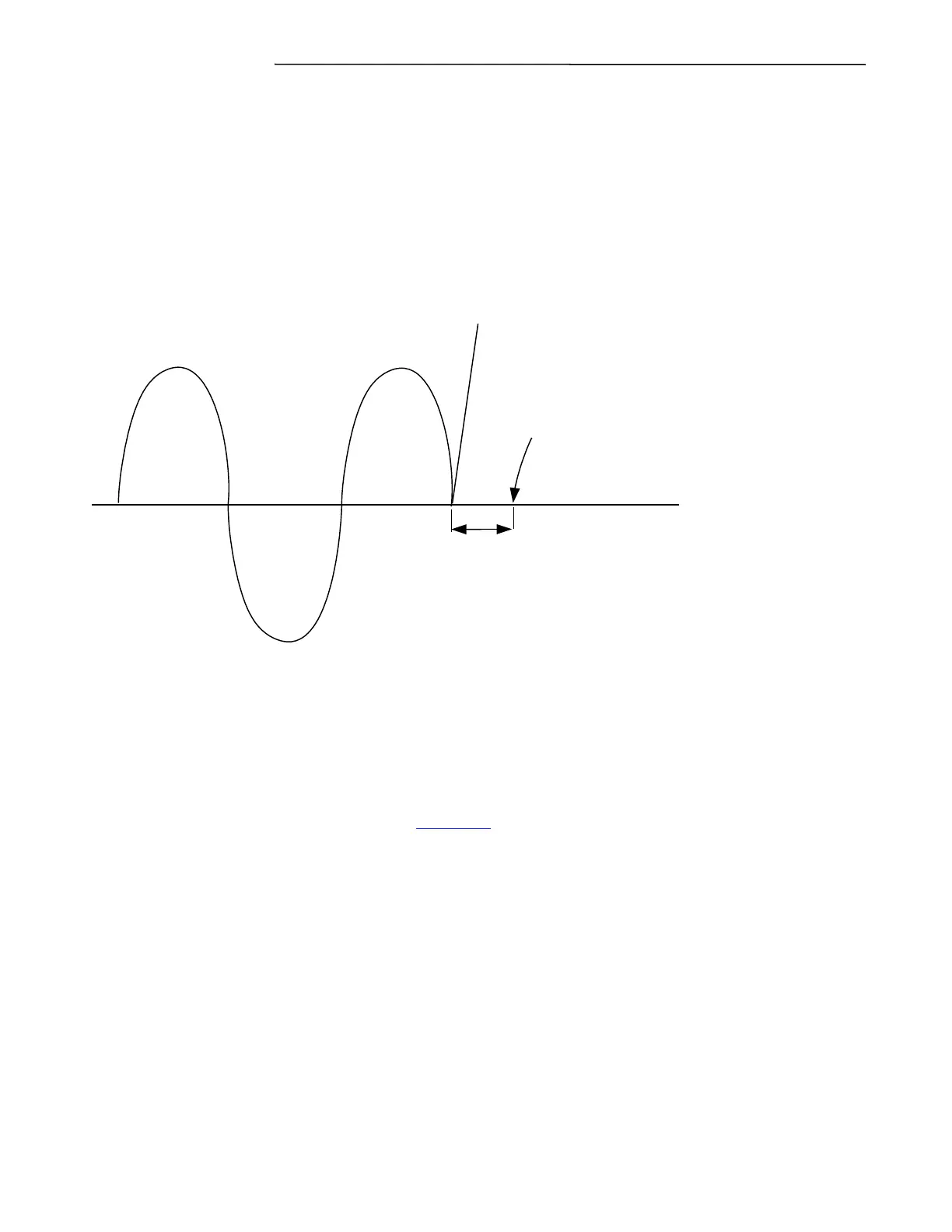
The polarity change fault detector is based upon expecting the current to continue to cross-through
zero and change polarity. The detector notes when the current reaches zero and then checks the
instantaneous current measurement four sample-periods later. There should be current of the opposite
polarity compared to that preceding the zero-cross.
This fault detector requires that the pre-zero-cross current be greater than approximately 1.5A
RMS
. If
both of these conditions are met the fault detector asserts. Note that this detector will assert if the
current remains at zero or inverts phase at or near the zero crossing.
The Polarity Change Fault Detector is active
when a change in current polarity is not
detected within 2 ms after a zero crossing
2 ms
Figure 13-34. Polarity Change Fault Detector
13.5.1.1.6 Breaker Closing Fault Detector
In order to account for charging currents and other transient conditions that occur when a breaker is
closed the relay is typically desensitized for a period after the breaker is closed. This is accomplished
using the bias boost as described in section 13.5.1.2.7. While this prevents the transient condition from
causing a trip some low-level fault conditions, however, may be masked by the bias boost.
When the boost is removed the normal protection algorithms will calculate a trip. A problem can arise
if the fault detectors are no longer active, as may be the case with boost durations of greater than
100ms. To work around this issue the breaker closing fault detector has been incorporated.
The breaker closing fault detector does not actually detect any fault; rather, it simulates a fault when
the boost timer expires. This allows the protection algorithms to generate a trip even if there are no
active fault detectors when the timer expires.


 To Next Page