Current Differential Relay
GARD 8000 SYS RFL Electronics
June 20, 2014 13-52 973.334.3100
13.5.1.1.7 Dual Breaker
Dual breakers are commonly used in protection where the current into that end of the line is the sum of
the currents in each CT. A problem may arise when there is an external fault that causes a large current
to flow through both CT's without going onto the line. Differences between the CT’s will appear to be
a current flowing into the line.
This issue is illustrated in the figure below. One waveform is phase A current at one line end and the
other waveform is phase A current at the remote end. While the currents start out being equal, ct
saturation of one of the summed ct’s start to distort the secondary current fed to the relay. Applying the
dual breaker option for GARD ensures that these types of errors would not result in a false operation,
even when using sensitive settings for the current differential relay.
The dual breaker system has two sets of CT inputs. The operation of the system is that the current for
each phase from the two inputs is added and used as the current input on that relay.
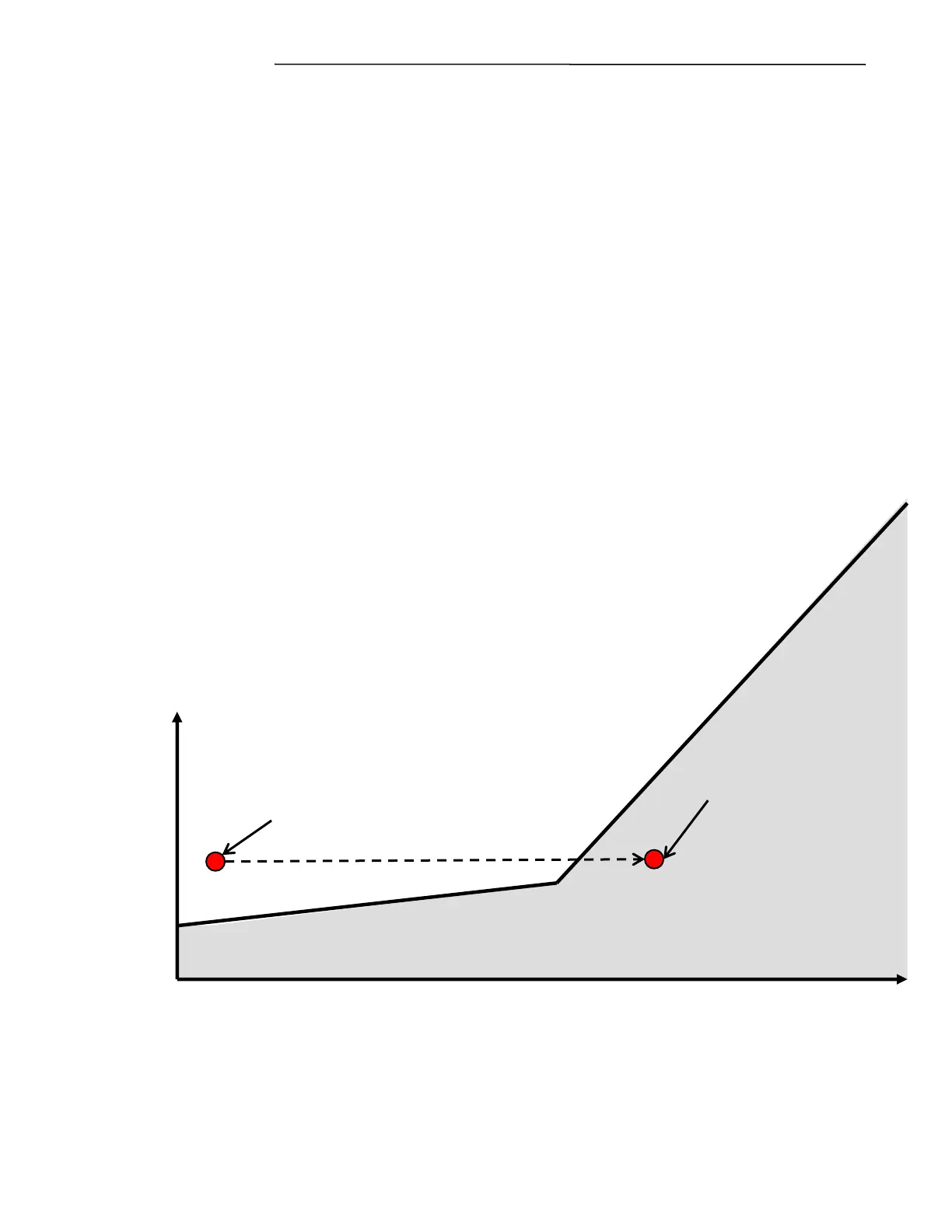
In practice, this means that the restraint current is moved from the lower end of the slope into the
higher restraint area:
Figure 13-35. Dual Breaker – Restraint Current
With both CT currents
added to the restraint


 To Next Page