Description
450
Instructions for use Zeus Infinity Empowered SW 2.n
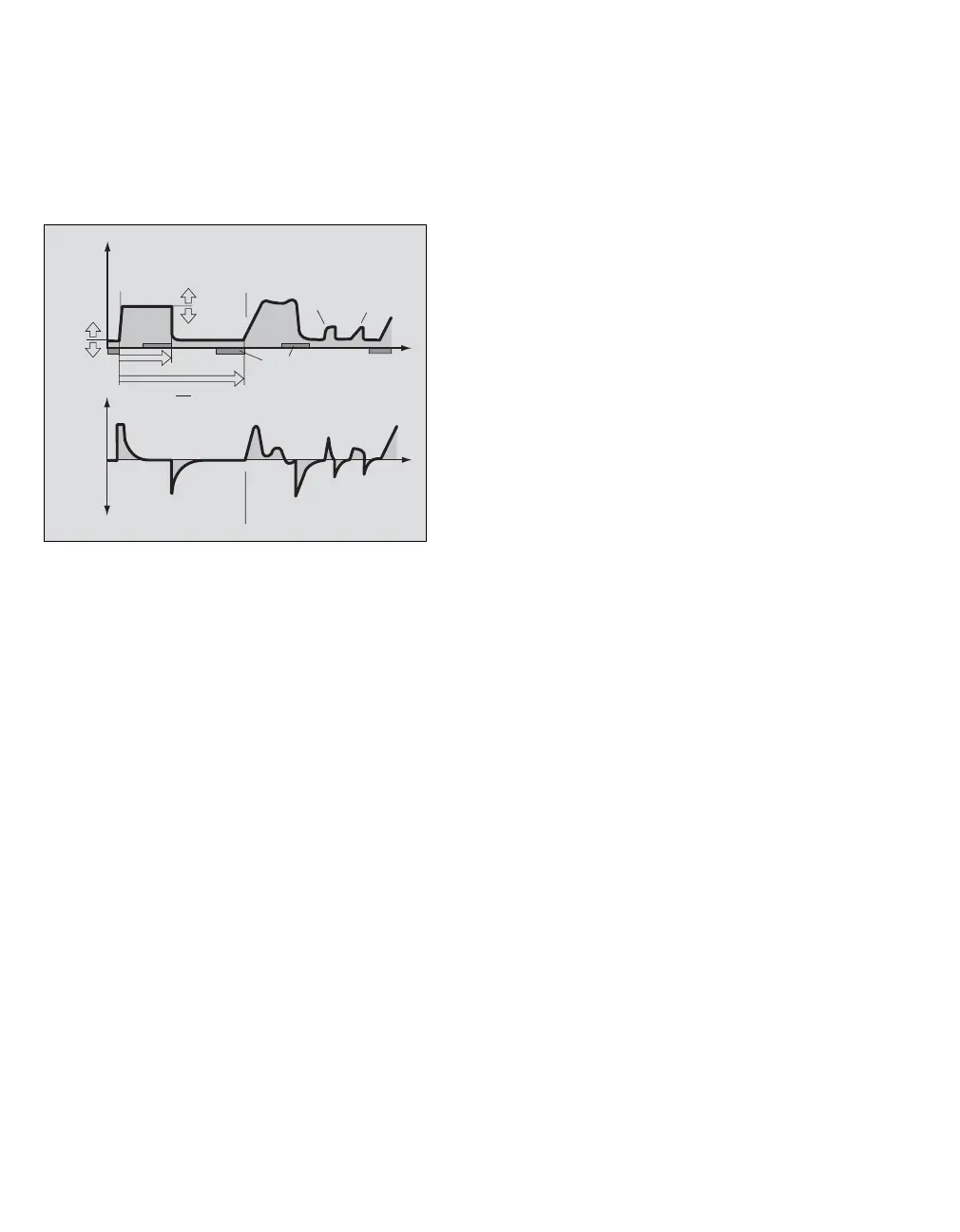
Synchronization with Vol. Ctrl. AutoFlow
(Sync. = ON)
Synchronized intermittent mandatory ventilation
This ventilation mode designates a hybrid form of
mechanical ventilation and spontaneous breathing
with volume-controlled and pressure-controlled
ventilation.
During synchronization with Vol. Ctrl. AutoFlow the
patient can only breathe spontaneously in predeter-
mined, regular pause times while mandatory venti-
lation breaths ensure minimum ventilation in the
meantime. This minimum ventilation is predeter-
mined with the two set points, tidal volume VT and
respiratory rate RR and results from the product
VT
e*RR.
The ventilation sample is determined with the set
points tidal volume VT, Flow, respiratory rate RR
and inspiration time Ti.
The flow trigger of the device ensures that the man-
datory ventilation breath is triggered within a "trig-
ger window" with spontaneous inspiration. This pre-
vents the mandatory ventilation breath from being
applied during spontaneous expiration.
The trigger window is 25 % of set inspiratory time at
the upper pressure level (P
insp), but a maximum of
5 seconds or 25 % of the time of expiration T
e.
However, on the PEEP level the maximum is
5 seconds. The trigger window can be switched off.
Since synchronization of the mandatory ventilation
breath shortens the effective Sync. time and thus
would undesirably increase the effective respiratory
rate, Zeus IE extends the following spontaneous
breathing time by the missing time difference ∆T.
Elevation of the Sync. respiratory rate is thus
avoided. The factor RR responsible for minimum
ventilation in addition to tidal volume VT remains
constant. If the patient has inspired a substantial
volume at the beginning of the trigger window, the
device reduces the following mandatory ventilation
breath. The time for the inspiratory flow phase and
inspiration time is shortened. Thus the tidal volume
VT remains constant and overfilling of the lungs is
avoided.
In the spontaneous breathing phases, the patient
can be assisted with Pressure Support.
In the course of further weaning, the respiratory
rate RR is further reduced at the device and thus
the spontaneous breathing time is prolonged. This
continues until finally the necessary minute volume
is mainly covered by spontaneous breathing. The
mandatory portion cannot be reduced to "zero".
258
t
t
1
fast rise
time
without spontaneous
breathing
with spontaneous breath-
ing
slow rise
time
Pressure support,
∆Psupp
fast rise
time
slow rise
time
Trigger window for insp. and exp.
synchronization
Paw
PEEP
Flow
RR
P
insp
Ti



 To Next Page