MPC5553/MPC5554 Microcontroller Reference Manual, Rev. 5
9-36 Freescale Semiconductor
The exact timing from this point is a function of the response times for the channel’s read and write
accesses. In this case of an slave read and internal SRAM write, the combined data phase time is 4
cycles. For an SRAM read and slave write, it is 5 cycles.
• Cycle n + 1: This cycle represents the data phase of the last destination write.
• Cycle n + 2: The eDMA engine completes the execution of the inner minor loop and prepares to
write back the required TCDn fields into the local memory. The control/status fields at word offset
0x1C in TCDn are read. If the major loop is complete, the MAJOR.E_LINK and E_SG bits are
checked and processed if enabled.
• Cycle n + 3: The appropriate fields in the first part of the TCDn are written back into the local
memory.
• Cycle n + 4: The fields in the second part of the TCDn are written back into the local memory. This
cycle coincides with the next channel arbitration cycle start.
• Cycle n + 5: The next channel to be activated performs the read of the first part of its TCD from
the local memory. This is equivalent to Cycle 4 for the first channel’s service request.
Assuming zero wait states on the system bus, DMA requests can be processed every 9 cycles. Assuming
an average of the access times associated with slave-to-SRAM (4 cycles) and SRAM-to-slave (5 cycles),
DMA requests can be processed every 11.5 cycles (4 + (4+5)/2 + 3). This is the time from Cycle 4 to Cycle
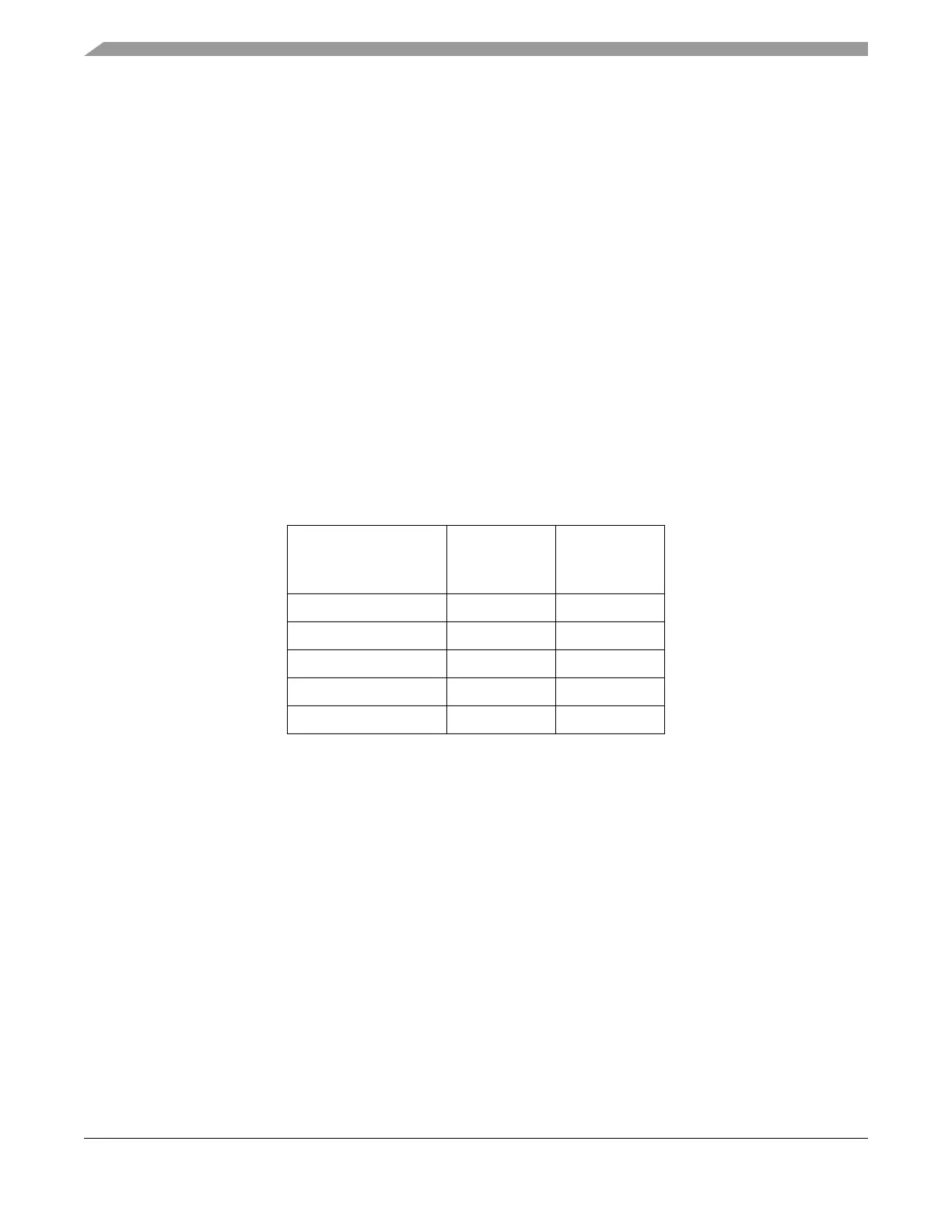
“n + 5.” The resulting peak request rate, as a function of the system frequency, is shown in Table 9-20. This
metric represents millions of requests per second.
A general formula to compute the peak request rate (with overlapping requests) is:
PEAKreq = freq / [ entry + (1 + read_ws) + (1 + write_ws) + exit ]
where:
PEAKreq - peak request rate
freq - system frequency
entry - channel startup (4 cycles)
read_ws - wait states seen during the system bus read data phase
write_ws - wait states seen during the system bus write data phase
exit - channel shutdown (3 cycles)
For example: consider a system with the following characteristics:
• Internal SRAM can be accessed with one wait-state when viewed from the system bus data phase.
• All slave reads require two wait-states, and slave writes three wait-states, again viewed from the
system bus data phase.
Table 9-20. eDMA Peak Request Rate (MReq/Sec)
System Frequency
(MHz)
Request Rate
(Zero Wait
States)
Request Rate
(with Wait
States)
66.6 7.4 5.8
83.3 9.2 7.2
100.0 11.1 8.7
133.3 14.8 11.6
150.0 16.6 13.0



 To Next Page